HomeAboutTraining CoursesFAQ
العربيةmohd@sbeeh.com+962 77 984 65 64
SBEEH Software Academy

Instructor-led IT training delivered by Microsoft Certified Trainers (MCT) — in Amman, Jordan, and across the GCC.

Explore

  • About Us
  • IT Training Courses
  • Verify a Certificate
  • FAQ

Get in Touch

  • +962-779846564
  • mohd@sbeeh.com
  • Amman, Jordan

SBEEH Software delivers software development services, advanced technologies implementation, business process automation, IT consulting, and professional IT training led by Microsoft Certified Trainers (MCT) for organizations across Jordan, Saudi Arabia, UAE, Qatar, Kuwait, Bahrain & Oman.

© SBEEH Software. All rights reserved. 2026.

Back to Training Courses
Advanced Cross-Platform Web Development with ASP.NET Core
.NET DevelopmentAdvancedFace to Face / Online

Advanced Cross-Platform Web Development with ASP.NET Core

Advanced Cross-Platform Web Development with ASP.NET Core is an advanced .NET Development course delivered in person and online by SBEEH Software Academy in Amman, Jordan.

5 Days (40 Hours)

Last updated August 16, 2026

This 5-day, advanced course takes experienced ASP.NET Core developers beyond core MVC/Razor skills into the architecture, performance, and production-operations concerns of large-scale ASP.NET Core applications. The course assumes participants can already build a working ASP.NET Core application (equivalent to the Developing Cross-Platform Web Applications course) and focuses entirely on what changes at scale: clean architecture, caching and performance, background processing, real-time communication, and production observability.

Participants restructure an application using clean architecture principles (separating domain, application, and infrastructure layers), implement output and distributed caching strategies, build background processing with hosted services and message queues, add real-time features with SignalR, and instrument the application with structured logging and distributed tracing for production diagnostics.

This course is designed for senior .NET developers and technical leads who already build ASP.NET Core applications and are now responsible for architecture decisions on larger, longer-lived, or higher-traffic systems, and for teams whose current ASP.NET Core applications have grown past the point where a single-project MVC structure remains maintainable.
Official reference: Microsoft Learn: .NET documentation

Day 1: Clean Architecture and Domain-Driven Design Patterns

Main Topics:

  • Layered/clean architecture for ASP.NET Core
  • Separating domain, application, and infrastructure layers
  • CQRS (Command Query Responsibility Segregation) overview
  • MediatR for decoupled request handling

Detailed Subtopics:

  • Structuring a multi-project solution around clean architecture boundaries
  • Domain entities vs. anemic data models
  • Implementing commands and queries with MediatR
  • Dependency direction and avoiding infrastructure leaking into the domain

Hands-On Lab: Refactor a single-project MVC application into a clean architecture solution with separated domain, application, and infrastructure projects, implementing one feature with CQRS via MediatR.

Real-World Scenario: A two-year-old application's controllers have become thousands of lines long, mixing business logic, data access, and HTTP concerns in the same file.

Learning Outcome: Participants can restructure an application using clean architecture principles that meaningfully improve testability and maintainability.

Day 2: Caching and Performance Optimization

Main Topics:

  • In-memory and distributed caching (Redis)
  • Output caching and response caching
  • Async/await performance patterns and pitfalls
  • Load testing and performance profiling

Detailed Subtopics:

  • Cache invalidation strategies
  • Configuring distributed caching for a multi-instance deployment
  • Avoiding common async anti-patterns (sync-over-async, thread pool starvation)
  • Using dotnet-trace and load testing tools to find real bottlenecks

Hands-On Lab: Add distributed caching (Redis) to a slow, database-heavy endpoint, load test it before and after, and fix an async anti-pattern found during profiling.

Real-World Scenario: The application's busiest endpoint is timing out under moderate concurrent load, and the team suspects a mix of missing caching and inefficient async code.

Learning Outcome: Participants can diagnose and fix real performance bottlenecks and implement appropriate caching strategies for a multi-instance deployment.

Day 3: Background Processing and Messaging

Main Topics:

  • Hosted services and IHostedService
  • Background job processing (queues, Hangfire/Azure Queue-based patterns)
  • Message-based decoupling between services
  • Idempotency and retry strategies

Detailed Subtopics:

  • Long-running vs. scheduled background services
  • Designing a reliable job queue for asynchronous work
  • Handling duplicate message delivery safely
  • Graceful shutdown and cancellation tokens

Hands-On Lab: Move a slow synchronous report-generation feature into a background job using a hosted service and a queue, with idempotent processing and proper cancellation handling.

Real-World Scenario: Generating a large export report currently blocks the user's HTTP request for over a minute, frequently causing timeouts.

Learning Outcome: Participants can design and implement reliable background processing that removes slow work from the request/response cycle.

Day 4: Real-Time Communication with SignalR

Main Topics:

  • SignalR hubs and connections
  • Groups and targeted messaging
  • Scaling SignalR across multiple server instances
  • Real-time UI update patterns

Detailed Subtopics:

  • Designing hub methods and client contracts
  • Broadcasting to specific users or groups
  • Using a backplane (Redis) for multi-instance SignalR
  • Handling connection drops and reconnection gracefully

Hands-On Lab: Add a real-time notification feature using SignalR so users see live status updates from the Day 3 background job without refreshing the page, configured to scale across multiple server instances.

Real-World Scenario: Users currently have to manually refresh the page to see whether their report has finished generating.

Learning Outcome: Participants can implement real-time, scalable features using SignalR appropriate for a multi-instance production deployment.

Day 5: Observability, Resilience, and Production Readiness

Main Topics:

  • Structured logging and distributed tracing
  • Health checks and readiness/liveness probes
  • Resilience patterns (retry, circuit breaker) with Polly
  • Capstone: production-readiness review

Detailed Subtopics:

  • Correlating logs and traces across services
  • Configuring health check endpoints for orchestration platforms
  • Implementing retry and circuit breaker policies for external dependencies
  • Building a production-readiness checklist

Hands-On Lab: Instrument the complete application built across the week with structured logging, distributed tracing, health checks, and a Polly-based retry/circuit breaker policy around an external dependency, then review it against a production-readiness checklist.

Real-World Scenario: A recent outage in a third-party payment API caused cascading failures across the whole application because there was no resilience policy protecting the rest of the system.

Learning Outcome: Participants leave with a genuinely production-ready, observable, resilient ASP.NET Core application and a checklist they can apply to their own systems.

Frequently Asked Questions

Additional Notes


Who Is This For?

This is an advanced course for developers already responsible for architecture decisions on larger or higher-traffic ASP.NET Core systems.

  • Senior .NET developers and technical leads responsible for application architecture
  • Development teams whose ASP.NET Core applications have outgrown a simple MVC structure
  • Solution architects designing large-scale or high-traffic .NET systems
  • Engineers preparing to take on production on-call responsibility for a .NET application

Prerequisites

This is an advanced course; participants should already build production ASP.NET Core applications before attending.

  • Working knowledge of ASP.NET Core (equivalent to the Developing Cross-Platform Web Applications with ASP.NET Core course)
  • Solid C# and object-oriented design experience
  • Basic familiarity with distributed systems concepts (caching, messaging) is helpful
  • Prior experience operating an application in production is strongly recommended

What certificate do I get after this course?

Upon successful completion of the training, participants will receive an official Certificate of Completion.
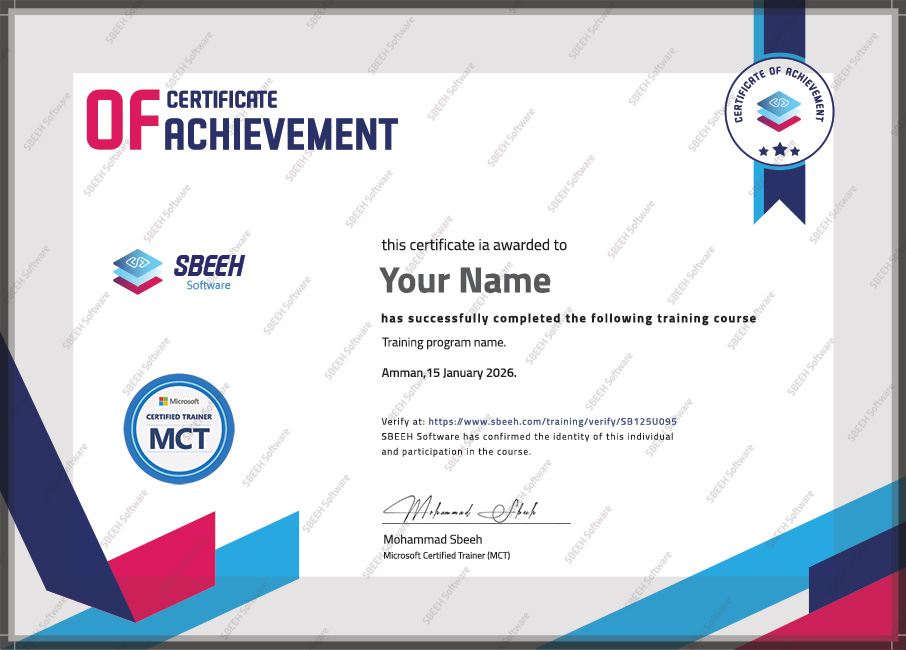

Certificate of Completion
Photo Gallery

Moments From This Training

A look at our training sessions — hands-on training sessions with professionals across Jordan and the GCC.

Interested in this training?

Reach out and we'll help you plan the right training for your team.

Back to all courses