HomeAboutTraining CoursesFAQ
العربيةmohd@sbeeh.com+962 77 984 65 64
SBEEH Software Academy

Instructor-led IT training delivered by Microsoft Certified Trainers (MCT) — in Amman, Jordan, and across the GCC.

Explore

  • About Us
  • IT Training Courses
  • Verify a Certificate
  • FAQ

Get in Touch

  • +962-779846564
  • mohd@sbeeh.com
  • Amman, Jordan

SBEEH Software delivers software development services, advanced technologies implementation, business process automation, IT consulting, and professional IT training led by Microsoft Certified Trainers (MCT) for organizations across Jordan, Saudi Arabia, UAE, Qatar, Kuwait, Bahrain & Oman.

© SBEEH Software. All rights reserved. 2026.

Back to Training Courses
Developing Cross-Platform Web Applications with ASP.NET Core
.NET DevelopmentIntermediateFace to Face / Online

Developing Cross-Platform Web Applications with ASP.NET Core

Developing Cross-Platform Web Applications with ASP.NET Core is an intermediate .NET Development course delivered in person and online by SBEEH Software Academy in Amman, Jordan.

5 Days (40 Hours)

Last updated August 16, 2026

This 5-day, intermediate course teaches developers to build cross-platform web applications using ASP.NET Core, covering both MVC-based server-rendered applications and Razor Pages, deployable on Windows, Linux, and macOS. The course focuses on the full request lifecycle of a real ASP.NET Core application: routing, controllers and Razor views, model binding and validation, dependency injection, and data access, rather than isolated framework features.

Participants build a multi-page web application with authentication, form handling, and database access, learn how ASP.NET Core's built-in dependency injection container shapes application architecture, implement middleware for cross-cutting concerns such as logging and error handling, and configure the application for deployment across operating systems using the cross-platform Kestrel web server.

This course is designed for .NET developers who know C# (or have completed the Object-Oriented Programming with C# course) and need to build server-rendered web applications, and for developers coming from classic ASP.NET or other web frameworks who need to adopt ASP.NET Core's modern, cross-platform architecture. It is a natural prerequisite for the Advanced Cross-Platform Web Development and Backend API Development courses.
Official reference: Microsoft Learn: .NET documentation

Day 1: ASP.NET Core Fundamentals and Routing

Main Topics:

  • ASP.NET Core architecture and the request pipeline
  • Middleware and Program.cs configuration
  • Routing: conventional and attribute routing
  • MVC vs. Razor Pages

Detailed Subtopics:

  • The generic host and cross-platform Kestrel server
  • Ordering middleware correctly
  • Route constraints and parameters
  • Choosing MVC vs. Razor Pages for a given feature

Hands-On Lab: Scaffold a new ASP.NET Core MVC application, configure custom middleware for request logging, and implement conventional and attribute-based routes.

Real-World Scenario: A company needs a new internal web application that must run identically on the developers' Windows laptops and the Linux production servers.

Learning Outcome: Participants understand the ASP.NET Core request pipeline and can configure routing and middleware correctly.

Day 2: Controllers, Views, and Model Binding

Main Topics:

  • Controllers and action methods
  • Razor syntax and layouts
  • Model binding and validation
  • Tag helpers and partial views

Detailed Subtopics:

  • Strongly-typed views and view models
  • Data annotations for validation
  • Client-side vs. server-side validation
  • Building reusable partial views and layouts

Hands-On Lab: Build a multi-page CRUD interface (create/edit/list) for a business entity, with validated forms using data annotations and tag helpers.

Real-World Scenario: The internal application needs a form for staff to submit and edit expense requests, with proper validation before submission.

Learning Outcome: Participants can build validated, well-structured Razor views bound correctly to strongly-typed models.

Day 3: Dependency Injection and Data Access

Main Topics:

  • Built-in dependency injection container
  • Service lifetimes (transient, scoped, singleton)
  • Data access with Entity Framework Core (overview)
  • Repository/service layer patterns

Detailed Subtopics:

  • Registering and injecting services into controllers
  • Choosing the correct service lifetime for a given service
  • Connecting a DbContext for data persistence
  • Separating business logic from controllers

Hands-On Lab: Register a service and repository layer via dependency injection, connect it to a database using Entity Framework Core, and refactor the Day 2 CRUD screens to use it.

Real-World Scenario: The expense form currently talks to the database directly from the controller, making the code hard to test and reuse.

Learning Outcome: Participants can design applications around dependency injection with clean separation between controllers, services, and data access.

Day 4: Authentication, Authorization, and Configuration

Main Topics:

  • ASP.NET Core Identity for authentication
  • Role- and policy-based authorization
  • Configuration and the options pattern
  • Environment-specific settings (appsettings.json)

Detailed Subtopics:

  • Securing controllers and actions with [Authorize]
  • Custom authorization policies
  • Strongly-typed configuration with IOptions
  • Managing secrets safely across environments

Hands-On Lab: Add ASP.NET Core Identity to the application, restrict the expense-approval screens to a Manager role, and move configuration values into strongly-typed options.

Real-World Scenario: Only managers should be able to approve expense requests, and the application needs different database connection settings between development and production.

Learning Outcome: Participants can secure an ASP.NET Core application with authentication and authorization and manage configuration correctly across environments.

Day 5: Error Handling, Logging, and Cross-Platform Deployment

Main Topics:

  • Global exception handling middleware
  • Structured logging with ILogger and providers
  • Publishing and running on Windows, Linux, and containers
  • Capstone: complete and deploy the application

Detailed Subtopics:

  • Custom error pages and problem details
  • Logging providers and log levels
  • Publishing self-contained vs. framework-dependent deployments
  • Running the application behind a reverse proxy (Nginx)

Hands-On Lab: Add global error handling and structured logging to the application, then publish and run it as a self-contained Linux deployment.

Real-World Scenario: The application is ready to move from a developer's machine onto a Linux production server behind Nginx, and needs proper error handling and logging in place first.

Learning Outcome: Participants leave with a complete, secured, cross-platform ASP.NET Core web application, published and running successfully outside Windows.

Frequently Asked Questions

Additional Notes


Who Is This For?

This course is for .NET developers building server-rendered web applications, distinct from developers focused purely on APIs or SPA frontends.

  • ASP.NET/.NET developers building internal or customer-facing web applications
  • Developers migrating from classic ASP.NET or ASP.NET MVC to ASP.NET Core
  • Full-stack developers who need a server-rendered UI layer over a data-driven backend
  • Solution architects planning a migration to cross-platform .NET

Prerequisites

Working C# knowledge is required; this course builds directly on object-oriented programming skills.

  • Working knowledge of C# and object-oriented programming (equivalent to the Object-Oriented Programming with C# course)
  • Basic understanding of HTML and HTTP request/response concepts
  • Basic SQL/database familiarity is helpful for the data access modules
  • Visual Studio 2022 or VS Code with the .NET SDK for labs

What certificate do I get after this course?

Upon successful completion of the training, participants will receive an official Certificate of Completion.
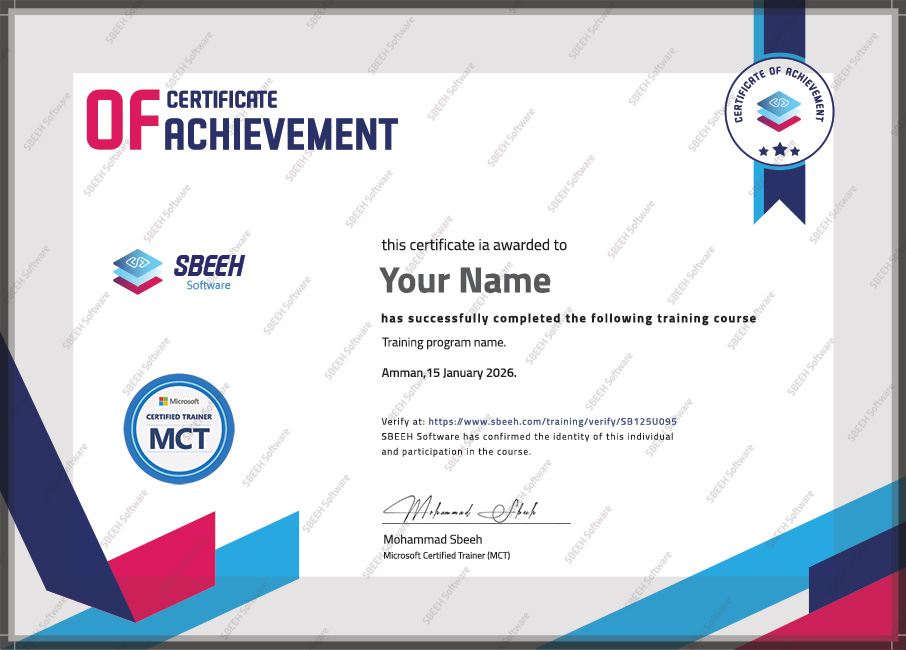

Certificate of Completion
Photo Gallery

Moments From This Training

A look at our training sessions — hands-on training sessions with professionals across Jordan and the GCC.

Interested in this training?

Reach out and we'll help you plan the right training for your team.

Back to all courses