HomeAboutTraining CoursesFAQ
العربيةmohd@sbeeh.com+962 77 984 65 64
SBEEH Software Academy

Instructor-led IT training delivered by Microsoft Certified Trainers (MCT) — in Amman, Jordan, and across the GCC.

Explore

  • About Us
  • IT Training Courses
  • Verify a Certificate
  • FAQ

Get in Touch

  • +962-779846564
  • mohd@sbeeh.com
  • Amman, Jordan

SBEEH Software delivers software development services, advanced technologies implementation, business process automation, IT consulting, and professional IT training led by Microsoft Certified Trainers (MCT) for organizations across Jordan, Saudi Arabia, UAE, Qatar, Kuwait, Bahrain & Oman.

© SBEEH Software. All rights reserved. 2026.

Back to Training Courses
Entity Framework Core for Modern Data Access
.NET DevelopmentIntermediateFace to Face / Online

Entity Framework Core for Modern Data Access

Entity Framework Core for Modern Data Access is an intermediate .NET Development course delivered in person and online by SBEEH Software Academy in Amman, Jordan.

3 Days (24 Hours)

Last updated August 16, 2026

This 3-day, intermediate course teaches .NET developers to build the data access layer of applications using Entity Framework Core, Microsoft's modern object-relational mapper (ORM). The course goes beyond basic CRUD operations to address the decisions that determine whether an EF Core data layer performs well in production: migration strategy, query performance and the N+1 problem, tracking vs. no-tracking queries, and concurrency handling.

Participants define a data model with the Code-First approach, generate and apply database migrations as the model evolves, write efficient LINQ queries against the database (understanding what SQL EF Core actually generates), configure relationships and eager/lazy loading correctly, and implement optimistic concurrency control for multi-user scenarios.

This course is designed for .NET developers who know C# and basic SQL and need to build the data access layer for an ASP.NET Core, Blazor, or other .NET application without hand-writing ADO.NET code for every operation. It builds directly on the Object-Oriented Programming with C# course and complements ASP.NET Core and Blazor training for teams building complete .NET applications.
Official reference: Microsoft Learn: .NET documentation

Day 1: EF Core Fundamentals and Code-First Modeling

Main Topics:

  • DbContext and DbSet configuration
  • Code-First model design
  • Data annotations and Fluent API
  • Basic CRUD with EF Core

Detailed Subtopics:

  • Configuring entity properties and keys
  • Fluent API vs. data annotations for configuration
  • Change tracking basics
  • Connection string and DbContext lifetime management

Hands-On Lab: Define a Code-First data model (e.g., orders and products) using Fluent API configuration, and implement basic CRUD operations against it.

Real-World Scenario: A new ASP.NET Core application needs a data access layer built without manually writing ADO.NET or raw SQL for every operation.

Learning Outcome: Participants can define an EF Core Code-First model and perform basic data operations correctly.

Day 2: Migrations, Relationships, and Query Performance

Main Topics:

  • EF Core Migrations
  • Configuring one-to-many and many-to-many relationships
  • Eager, lazy, and explicit loading
  • The N+1 query problem

Detailed Subtopics:

  • Generating and applying migrations safely in a team environment
  • Navigation properties and foreign key configuration
  • Include() and ThenInclude() for eager loading
  • Identifying and fixing N+1 query patterns

Hands-On Lab: Add a related entity (order lines) with a one-to-many relationship, generate and apply a migration, and identify and fix a deliberately introduced N+1 query problem using eager loading.

Real-World Scenario: A product listing page is making one database round trip per product to load its category, causing the page to load noticeably slowly with realistic data volumes.

Learning Outcome: Participants can manage schema evolution with migrations and write EF Core queries that generate efficient SQL, avoiding the N+1 problem.

Day 3: Advanced Querying, Concurrency, and Production Readiness

Main Topics:

  • Tracking vs. no-tracking queries
  • Raw SQL and stored procedure integration
  • Optimistic concurrency control
  • Performance and production best practices

Detailed Subtopics:

  • When to use AsNoTracking() for read-only scenarios
  • Calling existing stored procedures from EF Core
  • Implementing a concurrency token (rowversion) and handling conflicts
  • Connection resiliency and retry policies

Hands-On Lab: Add a concurrency token to an entity and handle a simulated concurrent-edit conflict correctly, then optimize a reporting query using no-tracking queries and measure the performance difference.

Real-World Scenario: Two staff members occasionally edit the same order record at nearly the same time, and one person's changes are currently silently overwriting the other's.

Learning Outcome: Participants leave able to design a production-ready EF Core data layer that handles concurrent access correctly and performs well under load.

Frequently Asked Questions

Additional Notes


Who Is This For?

This course is for .NET developers building the data access layer of an application, not database administrators.

  • ASP.NET Core and Blazor developers building the data layer of an application
  • .NET developers moving from raw ADO.NET or Dapper to a full ORM
  • Full-stack developers who need to design and evolve a database schema alongside application code
  • Technical leads evaluating EF Core for a new project's data access strategy

Prerequisites

Working C# and basic SQL knowledge are required; this course builds directly on core .NET programming skills.

  • Working knowledge of C# and object-oriented programming (equivalent to the Object-Oriented Programming with C# course)
  • Basic SQL querying knowledge (SELECT, JOIN, WHERE)
  • Familiarity with relational database concepts (keys, relationships)
  • Visual Studio 2022 or VS Code with the .NET SDK and SQL Server for labs

What certificate do I get after this course?

Upon successful completion of the training, participants will receive an official Certificate of Completion.
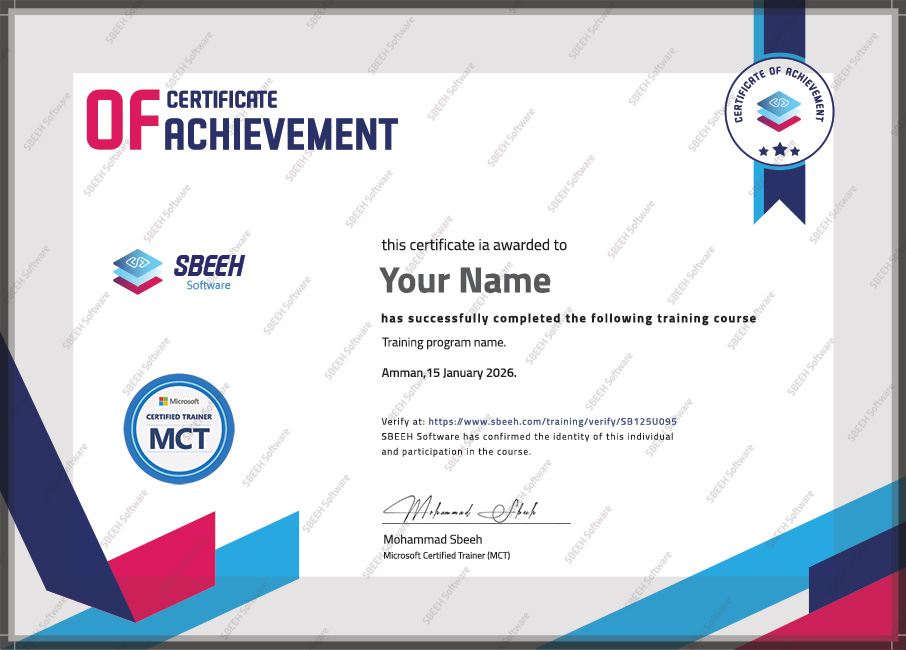

Certificate of Completion
Photo Gallery

Moments From This Training

A look at our training sessions — hands-on training sessions with professionals across Jordan and the GCC.

Interested in this training?

Reach out and we'll help you plan the right training for your team.

Back to all courses