HomeAboutTraining CoursesFAQ
العربيةmohd@sbeeh.com+962 77 984 65 64
SBEEH Software Academy

Instructor-led IT training delivered by Microsoft Certified Trainers (MCT) — in Amman, Jordan, and across the GCC.

Explore

  • About Us
  • IT Training Courses
  • Verify a Certificate
  • FAQ

Get in Touch

  • +962-779846564
  • mohd@sbeeh.com
  • Amman, Jordan

SBEEH Software delivers software development services, advanced technologies implementation, business process automation, IT consulting, and professional IT training led by Microsoft Certified Trainers (MCT) for organizations across Jordan, Saudi Arabia, UAE, Qatar, Kuwait, Bahrain & Oman.

© SBEEH Software. All rights reserved. 2026.

Back to Training Courses
Microsoft Azure Development for Cloud Solutions
Cloud & AzureIntermediateFace to Face / Online

Microsoft Azure Development for Cloud Solutions

Microsoft Azure Development for Cloud Solutions is an intermediate Cloud & Azure course delivered in person and online by SBEEH Software Academy in Amman, Jordan.

5 Days (40 Hours)

Last updated August 16, 2026

This 5-day, intermediate course teaches developers to design and build cloud-native applications and services on Microsoft Azure, aligned with the skills measured in the AZ-204: Developing Solutions for Microsoft Azure exam. The course covers the core building blocks every Azure application uses: compute hosting (App Service and Functions), storage, security, and messaging/eventing between services.

Participants build and deploy a web API to Azure App Service, implement serverless logic with Azure Functions triggered by HTTP, timers, and queues, secure an application with Azure AD and Managed Identities (avoiding hard-coded secrets entirely), work with Azure Storage (Blob and Queue) and Cosmos DB from application code, and connect services asynchronously using Service Bus and Event Grid.

This course is designed for backend and full-stack developers who already build applications in C#, Java, Node.js, or Python and need to build them as Azure-native cloud services rather than deploying unmodified on-premises-style applications. It complements Microsoft Azure Administration for developers who also need infrastructure fundamentals, and Developing NoSQL Solutions with Azure Cosmos DB for teams going deeper on data.
Official reference: Microsoft Learn: Azure documentation

Day 1: Azure Compute: App Service and Container Apps

Main Topics:

  • Deploying applications to Azure App Service
  • Deployment slots and CI/CD integration
  • Azure Container Apps overview
  • Application configuration and Key Vault references

Detailed Subtopics:

  • Choosing an App Service plan and scaling model
  • Zero-downtime deployment with slot swaps
  • Storing configuration securely with Key Vault references
  • Health checks and diagnostics logging

Hands-On Lab: Deploy a sample web API to Azure App Service using a staging slot, configure application settings to pull secrets from Key Vault, and perform a slot swap deployment.

Real-World Scenario: A team's current deployment process takes the application offline for several minutes during every release, which is no longer acceptable for a customer-facing API.

Learning Outcome: Participants can deploy and configure an application on Azure App Service with zero-downtime releases and secure configuration.

Day 2: Serverless Compute with Azure Functions

Main Topics:

  • Azure Functions triggers and bindings
  • HTTP, timer, and queue-triggered functions
  • Durable Functions for orchestration
  • Function app configuration and scaling

Detailed Subtopics:

  • Input/output bindings vs. imperative SDK code
  • Designing idempotent function logic
  • Chaining functions with Durable Functions orchestrators
  • Consumption vs. Premium hosting plans

Hands-On Lab: Build a set of Azure Functions: an HTTP-triggered API endpoint, a timer-triggered cleanup job, and a queue-triggered function that processes messages asynchronously.

Real-World Scenario: A nightly batch job currently runs on a manually managed VM that sits idle the rest of the day, and a new feature needs to process uploaded files asynchronously without blocking the main API.

Learning Outcome: Participants can design and implement serverless functions using the appropriate trigger for a given workload.

Day 3: Security: Azure AD, Managed Identities, and Key Vault

Main Topics:

  • Azure AD app registrations and OAuth 2.0 flows
  • Managed Identities for Azure resources
  • Securing APIs with Azure AD authentication
  • Azure Key Vault integration

Detailed Subtopics:

  • Client credentials vs. authorization code flows
  • System-assigned vs. user-assigned managed identities
  • Validating tokens in a protected API
  • Rotating and accessing secrets without storing connection strings in code

Hands-On Lab: Secure the Day 1 API with Azure AD authentication, assign it a managed identity, and use that identity to access Key Vault and a storage account without any secrets in application code or configuration.

Real-World Scenario: A security review flagged that a database connection string is currently stored in plain text in application settings, visible to anyone with portal access.

Learning Outcome: Participants can eliminate hard-coded secrets from an application entirely using managed identities and Key Vault.

Day 4: Data and Storage Integration

Main Topics:

  • Azure Blob Storage from application code
  • Azure Queue Storage for decoupling
  • Cosmos DB SDK integration (overview)
  • Caching with Azure Cache for Redis

Detailed Subtopics:

  • Uploading, downloading, and generating SAS tokens for Blob Storage
  • Using Queue Storage to decouple slow operations from API responses
  • Basic CRUD against Cosmos DB from the Functions app
  • Cache-aside pattern with Redis

Hands-On Lab: Extend the file-upload feature to store files in Blob Storage with time-limited SAS URLs, queue a processing message, and cache frequently accessed API responses in Redis.

Real-World Scenario: The API's most frequently requested endpoint hits the database on every call, and file uploads currently block the request until processing completes.

Learning Outcome: Participants can integrate storage, queuing, and caching services into an application to improve performance and responsiveness.

Day 5: Messaging, Events, and Monitoring

Main Topics:

  • Service Bus queues and topics
  • Event Grid for event-driven architecture
  • Application Insights for monitoring
  • Capstone: complete event-driven solution

Detailed Subtopics:

  • Choosing Service Bus vs. Queue Storage vs. Event Grid for a given scenario
  • Publish/subscribe with Service Bus topics
  • Reacting to Blob Storage events with Event Grid
  • Distributed tracing and custom telemetry with Application Insights

Hands-On Lab: Wire the file-processing pipeline built across the week into an event-driven flow: a Blob Storage event triggers processing via Event Grid, with Application Insights tracing the full request across services.

Real-World Scenario: When a file fails to process, the team currently has no way to trace what happened across the API, the queue, and the processing function.

Learning Outcome: Participants leave with a complete, secured, observable, event-driven Azure application, and the skills directly aligned with AZ-204 exam objectives.

Frequently Asked Questions

Additional Notes


Who Is This For?

This course is for developers building cloud-native applications and services on Azure, not for infrastructure administrators.

  • Backend and full-stack developers building applications hosted on Azure
  • Developers migrating existing applications to a cloud-native architecture
  • Solution architects designing Azure application architectures
  • Technical consultants preparing for the AZ-204 certification exam

Prerequisites

Working programming experience and basic Azure familiarity are required; this is not an introductory programming course.

  • Working programming experience in C#, Java, Node.js, or Python (labs use C#/.NET)
  • Basic understanding of REST APIs and HTTP
  • Recommended: basic Azure fundamentals knowledge (AZ-900 level) or equivalent exposure
  • An Azure subscription for hands-on labs (trial subscriptions are sufficient)

What certificate do I get after this course?

Upon successful completion of the training, participants will receive an official Certificate of Completion.
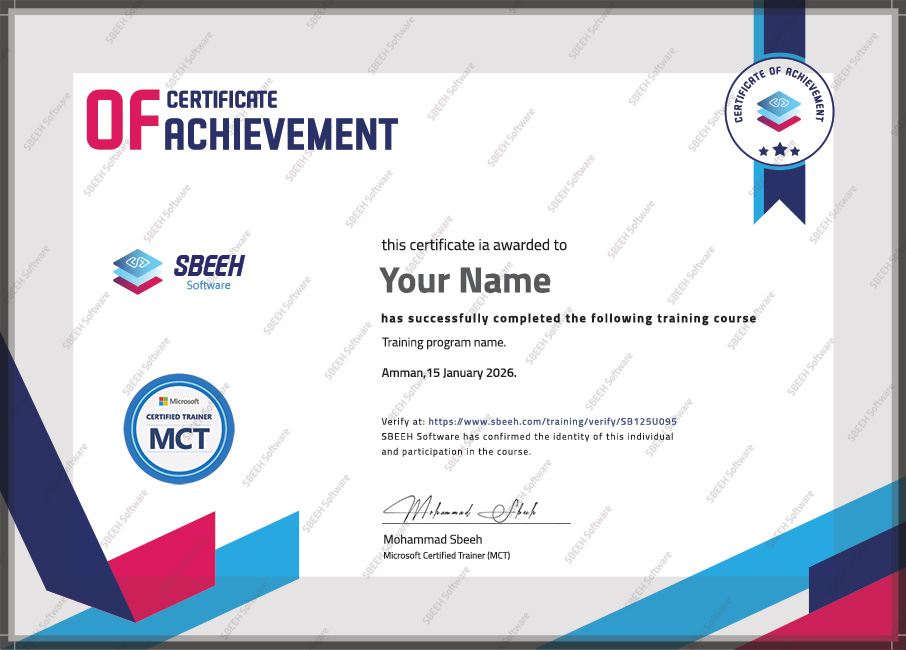

Certificate of Completion
Photo Gallery

Moments From This Training

A look at our training sessions — hands-on training sessions with professionals across Jordan and the GCC.

Interested in this training?

Reach out and we'll help you plan the right training for your team.

Back to all courses