HomeAboutTraining CoursesFAQ
العربيةmohd@sbeeh.com+962 77 984 65 64
SBEEH Software Academy

Instructor-led IT training delivered by Microsoft Certified Trainers (MCT) — in Amman, Jordan, and across the GCC.

Explore

  • About Us
  • IT Training Courses
  • Verify a Certificate
  • FAQ

Get in Touch

  • +962-779846564
  • mohd@sbeeh.com
  • Amman, Jordan

SBEEH Software delivers software development services, advanced technologies implementation, business process automation, IT consulting, and professional IT training led by Microsoft Certified Trainers (MCT) for organizations across Jordan, Saudi Arabia, UAE, Qatar, Kuwait, Bahrain & Oman.

© SBEEH Software. All rights reserved. 2026.

Back to Training Courses
MongoDB NoSQL Database Development
DatabaseBeginnerFace to Face / Online

MongoDB NoSQL Database Development

MongoDB NoSQL Database Development is a beginner Database course delivered in person and online by SBEEH Software Academy in Amman, Jordan.

3 Days (24 Hours)

Last updated August 16, 2026

This 3-day course teaches developers how to design, query, and build applications against MongoDB, the most widely used document-oriented NoSQL database. The course is built around the central question every relational-trained developer asks first: how do I model data without foreign keys and joins? Participants learn document schema design, embedding vs. referencing trade-offs, the MongoDB Query Language (MQL), indexing, and the aggregation framework used for reporting and analytics workloads.

Rather than treating MongoDB as 'SQL Server without a schema,' the course teaches document modeling as a discipline of its own: designing around access patterns rather than around normalized entities, understanding when to embed related data for read performance versus when to reference it, and using the aggregation pipeline to replace complex SQL joins and GROUP BY queries.

This course is designed for backend and full-stack developers building applications with variable or nested data (content management, catalogs, IoT/event data, user profiles) who need an alternative to a purely relational data layer, and for developers already using MongoDB informally who want to learn correct schema design and indexing practices instead of ad hoc query writing.
Official reference: Microsoft Learn: SQL Server documentation

Day 1: Document Modeling and CRUD Operations

Main Topics:

  • MongoDB architecture: databases, collections, documents
  • BSON data types
  • CRUD operations with the MongoDB Query Language
  • Schema design: embedding vs. referencing

Detailed Subtopics:

  • Designing documents around application access patterns
  • One-to-few, one-to-many, and one-to-squillions relationships
  • Data validation with JSON Schema
  • Using MongoDB Compass and the shell

Hands-On Lab: Design and populate a document schema for a blogging platform (posts with embedded comments vs. referenced authors) and perform CRUD operations against it.

Real-World Scenario: A content platform needs a flexible schema for articles that have varying numbers of tags, embedded comments, and optional metadata fields.

Learning Outcome: Participants can design a document schema appropriate to a given access pattern and perform all core CRUD operations confidently.

Day 2: Querying, Indexing, and Data Integrity

Main Topics:

  • Advanced query operators and projections
  • Single-field, compound, and multikey indexes
  • Explain plans and query performance
  • Schema validation rules

Detailed Subtopics:

  • Query operators for arrays and nested documents
  • Index selectivity and covered queries
  • Using explain() to diagnose collection scans
  • Enforcing required fields and types with $jsonSchema

Hands-On Lab: Add compound and multikey indexes to the Day 1 database, then use explain() to confirm queries switch from collection scans to index scans.

Real-World Scenario: The blog platform's tag-search feature has become slow as the posts collection grows past hundreds of thousands of documents.

Learning Outcome: Participants can design and validate indexes that meaningfully improve query performance and can read query execution statistics.

Day 3: The Aggregation Framework and Application Integration

Main Topics:

  • Aggregation pipeline stages
  • $match, $group, $lookup, $project, $unwind
  • Integrating MongoDB with a Node.js/.NET application via drivers
  • Transactions and consistency in MongoDB

Detailed Subtopics:

  • Replacing SQL GROUP BY and JOIN logic with pipeline stages
  • Multi-stage pipelines for reporting
  • Using the official MongoDB driver from application code
  • Multi-document ACID transactions and when they're needed

Hands-On Lab: Build an aggregation pipeline that produces a monthly post-count and top-commenter report, then call it from a small sample application using the MongoDB driver.

Real-World Scenario: The content team needs a monthly analytics dashboard showing publishing volume and engagement without exporting data to a separate reporting tool.

Learning Outcome: Participants can build multi-stage aggregation pipelines for real reporting needs and integrate MongoDB into an application using an official driver.

Frequently Asked Questions

Additional Notes


Who Is This For?

This course is for developers who need to model and query data outside a traditional relational structure.

  • Backend and full-stack developers building applications with flexible or nested data models
  • Developers already using MongoDB ad hoc who want proper schema design and indexing skills
  • Solution architects evaluating NoSQL options for a new project
  • Data professionals expanding beyond relational databases

Prerequisites

No prior NoSQL experience is required, but basic database and programming concepts are assumed.

  • Basic understanding of databases and querying concepts (SQL experience is helpful but not required)
  • Comfort with JSON syntax
  • Basic programming experience in any language for the driver-integration exercises
  • MongoDB Community Edition and MongoDB Compass, installed and provided during setup

What certificate do I get after this course?

Upon successful completion of the training, participants will receive an official Certificate of Completion.
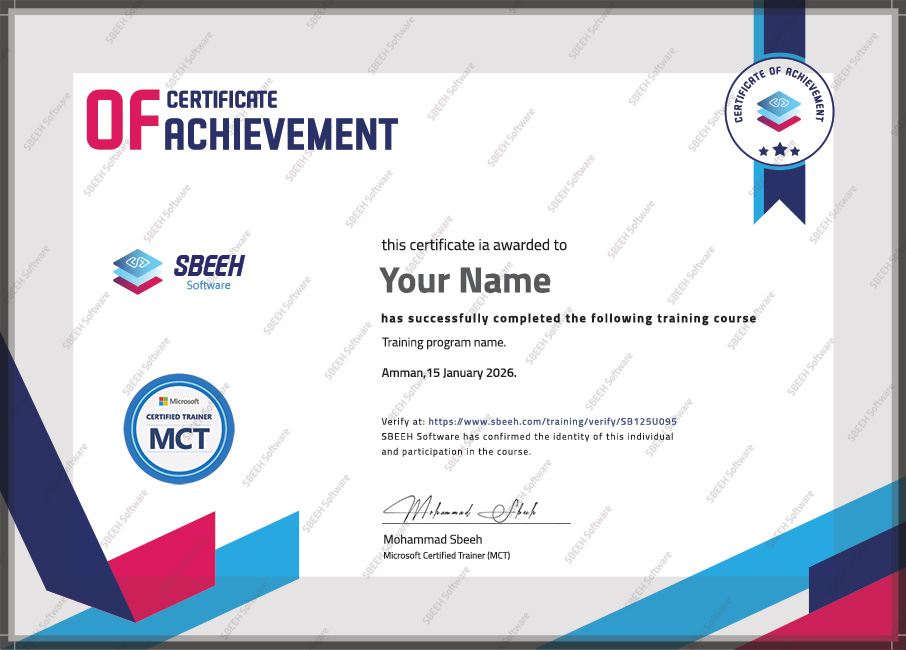

Certificate of Completion
Photo Gallery

Moments From This Training

A look at our training sessions — hands-on training sessions with professionals across Jordan and the GCC.

Interested in this training?

Reach out and we'll help you plan the right training for your team.

Back to all courses