HomeAboutTraining CoursesFAQ
العربيةmohd@sbeeh.com+962 77 984 65 64
SBEEH Software Academy

Instructor-led IT training delivered by Microsoft Certified Trainers (MCT) — in Amman, Jordan, and across the GCC.

Explore

  • About Us
  • IT Training Courses
  • Verify a Certificate
  • FAQ

Get in Touch

  • +962-779846564
  • mohd@sbeeh.com
  • Amman, Jordan

SBEEH Software delivers software development services, advanced technologies implementation, business process automation, IT consulting, and professional IT training led by Microsoft Certified Trainers (MCT) for organizations across Jordan, Saudi Arabia, UAE, Qatar, Kuwait, Bahrain & Oman.

© SBEEH Software. All rights reserved. 2026.

Back to Training Courses
Developing NoSQL Solutions with Azure Cosmos DB
DatabaseIntermediateFace to Face / Online

Developing NoSQL Solutions with Azure Cosmos DB

Developing NoSQL Solutions with Azure Cosmos DB is an intermediate Database course delivered in person and online by SBEEH Software Academy in Amman, Jordan.

4 Days (32 Hours)

Last updated August 16, 2026

This 4-day, intermediate course teaches developers to design and build applications on Azure Cosmos DB, Microsoft's globally distributed, multi-model NoSQL database service. The course focuses on the decisions that determine whether a Cosmos DB application performs well and stays affordable: partition key design, request unit (RU) consumption, consistency level selection, and indexing policy — areas where poor decisions are expensive to reverse after data has been loaded.

Participants design a partition strategy for a real workload, work with the Core (SQL) API to query and model documents, configure indexing policies to control RU cost, choose an appropriate consistency level for a given use case, and implement the change feed to build event-driven, reactive application features. The course also covers Cosmos DB's global distribution and multi-region writes for applications with a worldwide user base.

This course is designed for backend and cloud developers building applications on Azure that need low-latency, globally distributed data access, and for solution architects evaluating Cosmos DB against alternatives for a new system. It pairs naturally with Microsoft Azure Development for Cloud Solutions for teams building broader Azure-native applications.
Official reference: Microsoft Learn: SQL Server documentation

Day 1: Cosmos DB Fundamentals and Data Modeling

Main Topics:

  • Cosmos DB APIs (Core/SQL, MongoDB, Cassandra, Gremlin, Table)
  • Containers, items, and logical partitions
  • Data modeling for NoSQL access patterns
  • Provisioned throughput vs. serverless

Detailed Subtopics:

  • Choosing embedding vs. referencing for related data
  • Estimating request units (RUs) for common operations
  • Fixed vs. autoscale throughput
  • When to choose serverless Cosmos DB

Hands-On Lab: Model and create a container for a multi-tenant application, populate it with sample data via the Core (SQL) API, and inspect RU consumption for common operations.

Real-World Scenario: A SaaS application needs a data model that keeps each tenant's data efficiently queryable without cross-tenant data leakage.

Learning Outcome: Participants can design an item schema appropriate to their access patterns and understand how design choices affect RU cost.

Day 2: Partitioning Strategy and Query Performance

Main Topics:

  • Choosing an effective partition key
  • Cross-partition vs. single-partition queries
  • Indexing policies
  • Query performance tuning

Detailed Subtopics:

  • Avoiding 'hot partition' problems
  • Synthetic partition keys for high-cardinality workloads
  • Customizing included/excluded paths in the indexing policy
  • Reading query metrics (RU charge) to optimize queries

Hands-On Lab: Redesign a poorly performing container that suffers from a hot-partition problem, apply a synthetic partition key, and tune the indexing policy to reduce RU cost by a measurable amount.

Real-World Scenario: A container partitioned by 'tenantId' has one very large enterprise tenant causing severe throttling for every other tenant sharing the same physical partition.

Learning Outcome: Participants can diagnose and fix partition-related performance and cost problems in a Cosmos DB container.

Day 3: Consistency Levels and the Change Feed

Main Topics:

  • The five consistency levels and their trade-offs
  • Choosing consistency per application scenario
  • The change feed and its processing model
  • Azure Functions triggers on the change feed

Detailed Subtopics:

  • Session consistency as the practical default
  • Strong vs. eventual consistency cost/performance trade-offs
  • Building an event-driven pipeline from container changes
  • Idempotency in change feed processors

Hands-On Lab: Configure a change feed processor (via Azure Functions) that reacts to new orders being written to a container and sends a notification, then experiment with different consistency levels and observe read-after-write behavior.

Real-World Scenario: An order-processing system needs to trigger a fulfillment workflow automatically the moment a new order document is written, without polling the database.

Learning Outcome: Participants can select an appropriate consistency level for a given scenario and build reactive, event-driven features using the change feed.

Day 4: Global Distribution, Security, and Capstone

Main Topics:

  • Multi-region replication and multi-region writes
  • Conflict resolution policies
  • Security: RBAC, network isolation, encryption
  • Capstone: complete a globally-aware application feature

Detailed Subtopics:

  • Failover priorities and manual vs. automatic failover
  • Last-writer-wins vs. custom conflict resolution
  • Role-based access control for Cosmos DB accounts
  • Cost monitoring and budget alerts

Hands-On Lab: Enable multi-region writes on a Cosmos DB account, configure a conflict resolution policy, and verify writes replicate correctly across regions in the portal.

Real-World Scenario: A global retail application needs low-latency writes for users in both Europe and the Middle East, with automatic conflict resolution if the same item is edited in two regions simultaneously.

Learning Outcome: Participants leave able to design and secure a globally distributed Cosmos DB solution end to end.

Frequently Asked Questions

Additional Notes


Who Is This For?

This course is for developers and architects building applications that need Cosmos DB's global scale and NoSQL flexibility, not general NoSQL beginners.

  • Backend and cloud developers building Azure-native applications
  • Solution architects evaluating Cosmos DB for a new or migrating system
  • Developers already using another NoSQL database who need Cosmos DB-specific design skills
  • Data engineers building event-driven pipelines from operational data

Prerequisites

Prior Azure and general database experience is expected; this is not an introductory NoSQL or Azure course.

  • Working knowledge of Azure fundamentals (recommended: AZ-900 level or equivalent experience)
  • General programming experience in any language (labs use C# or JavaScript SDK examples)
  • Basic understanding of NoSQL/document database concepts is helpful but not required
  • An Azure subscription for hands-on labs (trial subscriptions are sufficient)

What certificate do I get after this course?

Upon successful completion of the training, participants will receive an official Certificate of Completion.
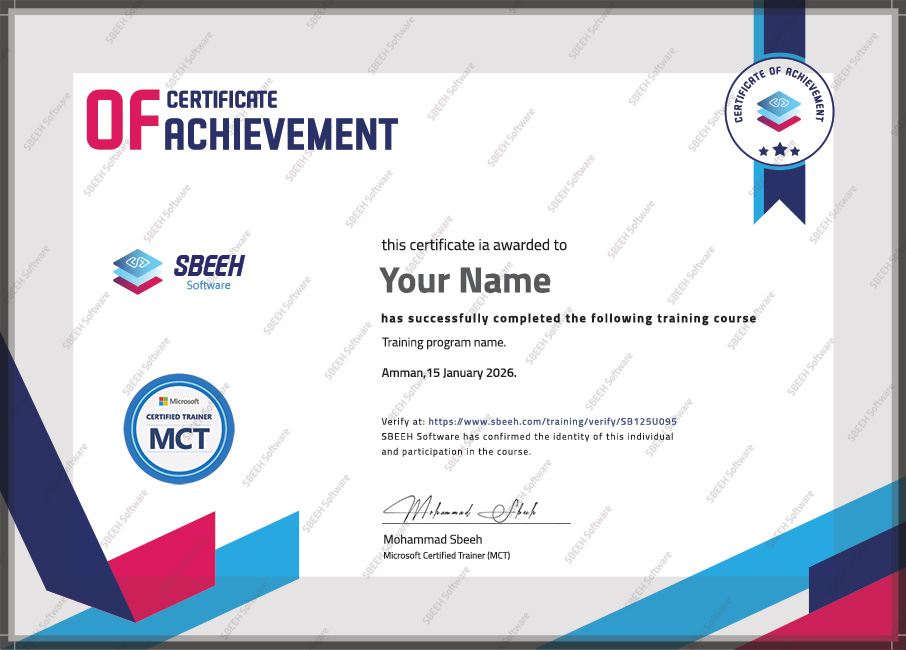

Certificate of Completion
Photo Gallery

Moments From This Training

A look at our training sessions — hands-on training sessions with professionals across Jordan and the GCC.

Interested in this training?

Reach out and we'll help you plan the right training for your team.

Back to all courses