HomeAboutTraining CoursesFAQ
العربيةmohd@sbeeh.com+962 77 984 65 64
SBEEH Software Academy

Instructor-led IT training delivered by Microsoft Certified Trainers (MCT) — in Amman, Jordan, and across the GCC.

Explore

  • About Us
  • IT Training Courses
  • Verify a Certificate
  • FAQ

Get in Touch

  • +962-779846564
  • mohd@sbeeh.com
  • Amman, Jordan

SBEEH Software delivers software development services, advanced technologies implementation, business process automation, IT consulting, and professional IT training led by Microsoft Certified Trainers (MCT) for organizations across Jordan, Saudi Arabia, UAE, Qatar, Kuwait, Bahrain & Oman.

© SBEEH Software. All rights reserved. 2026.

Back to Training Courses
Microsoft Power Platform Solution Architect – Level 3
Power PlatformAdvancedFace to Face / Online

Microsoft Power Platform Solution Architect – Level 3

Microsoft Power Platform Solution Architect – Level 3 is an advanced Power Platform course delivered in person and online by SBEEH Software Academy in Amman, Jordan.

4 Days (32 Hours)

Last updated August 16, 2026

This 4-day, advanced course prepares experienced Power Platform practitioners to design enterprise-grade solutions as a Solution Architect, aligned with the skills measured in Microsoft's PL-600 exam. Unlike the Functional Consultant and Developer courses, which focus on building individual apps, flows, or components, this course focuses on the architectural decisions that span an entire Power Platform implementation: environment strategy, Dataverse data modeling at scale, application lifecycle management (ALM), integration architecture, and governance.

Participants design a multi-environment strategy for an enterprise implementation, model complex Dataverse relationships and security roles for a multi-business-unit organization, design an ALM pipeline using solutions and managed environments, and architect integration between Power Platform and external systems (Azure services, third-party APIs) using appropriate patterns. The course also covers the non-technical architect responsibilities: requirements gathering, stakeholder alignment, and evaluating build-vs-buy trade-offs within the platform.

This course is designed for experienced Power Platform consultants, developers, and technical architects who already have hands-on delivery experience (typically from the Functional Consultant and Developer courses or equivalent project work) and are now moving into an architecture and governance leadership role across multiple Power Platform projects.
Official reference: Microsoft Learn: Power Platform documentation

Day 1: Solution Architecture Fundamentals and Requirements

Main Topics:

  • The Solution Architect role and responsibilities
  • Requirements gathering and solution envisioning
  • Capability mapping and fit-gap analysis
  • Architecture documentation standards

Detailed Subtopics:

  • Translating business requirements into a technical architecture
  • Choosing between Power Platform, custom development, and third-party products
  • Documenting architecture decisions and trade-offs
  • Stakeholder communication for technical architecture

Hands-On Lab: Given a business requirements document for a multi-department case-management system, produce a fit-gap analysis and a high-level solution architecture document.

Real-World Scenario: An organization wants to replace three disconnected departmental systems with a single Power Platform solution but has conflicting requirements between departments.

Learning Outcome: Participants can translate ambiguous business requirements into a defensible, documented solution architecture.

Day 2: Dataverse Architecture and Security at Scale

Main Topics:

  • Enterprise Dataverse data modeling
  • Business units, teams, and security role design
  • Field-level and row-level security
  • Auditing and compliance considerations

Detailed Subtopics:

  • Designing entity relationships for a multi-business-unit organization
  • Security role inheritance and least-privilege design
  • Hierarchical and matrix security models
  • Data residency and compliance considerations for regulated industries

Hands-On Lab: Design a Dataverse security model for a multi-business-unit organization with hierarchical access requirements, including a matrix security scenario for cross-department collaboration.

Real-World Scenario: A holding company with three subsidiaries needs staff in each subsidiary to see only their own data, while a small central finance team needs visibility across all three.

Learning Outcome: Participants can design a Dataverse security architecture that correctly balances access needs against data protection requirements.

Day 3: Application Lifecycle Management and Environment Strategy

Main Topics:

  • Environment strategy (dev, test, UAT, production)
  • Managed vs. unmanaged solutions
  • ALM pipelines with Azure DevOps/GitHub
  • Managed environments and governance features

Detailed Subtopics:

  • Designing an environment topology for multiple concurrent projects
  • Solution layering and dependency management
  • Automating solution deployment with pipelines
  • Data Loss Prevention (DLP) policies at the tenant level

Hands-On Lab: Design a multi-environment ALM strategy for an organization running several concurrent Power Platform projects, and configure a solution pipeline to promote a solution from dev through to production.

Real-World Scenario: Multiple teams are currently building directly in a single shared environment, causing conflicting changes and unreliable deployments.

Learning Outcome: Participants can design and implement an ALM strategy appropriate to an organization running multiple concurrent Power Platform initiatives.

Day 4: Integration Architecture and Capstone

Main Topics:

  • Integration patterns: connectors, custom connectors, Azure integration
  • Dataverse plug-ins and Power Automate vs. Azure Logic Apps
  • Performance and scalability considerations
  • Capstone: enterprise architecture design and presentation

Detailed Subtopics:

  • Choosing between a custom connector, a plug-in, and an external Azure integration
  • Synchronous vs. asynchronous integration patterns
  • Designing for API throttling limits at scale
  • Presenting and defending an architecture decision to stakeholders

Hands-On Lab: Design the end-to-end integration architecture for the case-management system from Day 1, connecting Dataverse to an external line-of-business system via Azure Logic Apps, and present the complete architecture to the group.

Real-World Scenario: The case-management system needs to synchronize customer records bi-directionally with an external legacy CRM that has strict API rate limits.

Learning Outcome: Participants leave able to design and defend a complete, enterprise-grade Power Platform solution architecture, aligned with PL-600 exam objectives.

Frequently Asked Questions

Additional Notes


Who Is This For?

This is an advanced, architecture-focused course for experienced Power Platform practitioners moving into a leadership role across projects.

  • Experienced Power Platform consultants and developers moving into a solution architect role
  • Technical architects responsible for enterprise Power Platform governance
  • IT managers overseeing multiple concurrent Power Platform initiatives
  • Senior consultants preparing for the PL-600 certification exam

Prerequisites

This course assumes substantial prior hands-on Power Platform delivery experience; it is not an introduction to Power Platform.

  • Hands-on Power Platform delivery experience (equivalent to the Functional Consultant and Developer courses or real project experience)
  • Working knowledge of Dataverse data modeling and security concepts
  • Familiarity with Power Automate and basic Azure integration concepts
  • Prior experience gathering requirements or leading a technical solution design is strongly recommended

What certificate do I get after this course?

Upon successful completion of the training, participants will receive an official Certificate of Completion.
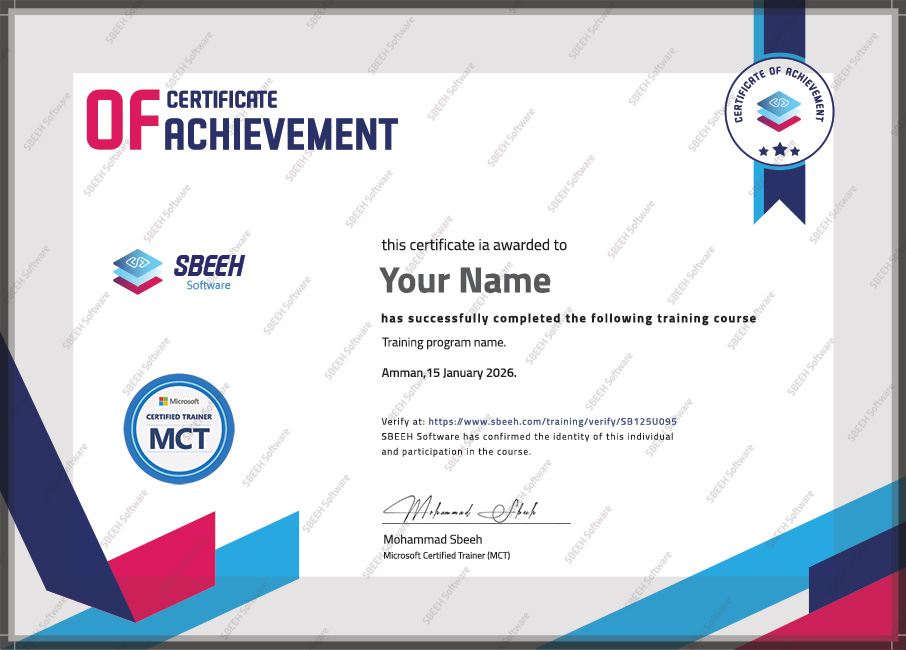

Certificate of Completion
Photo Gallery

Moments From This Training

A look at our training sessions — hands-on training sessions with professionals across Jordan and the GCC.

Interested in this training?

Reach out and we'll help you plan the right training for your team.

Back to all courses