HomeAboutTraining CoursesFAQ
العربيةmohd@sbeeh.com+962 77 984 65 64
SBEEH Software Academy

Instructor-led IT training delivered by Microsoft Certified Trainers (MCT) — in Amman, Jordan, and across the GCC.

Explore

  • About Us
  • IT Training Courses
  • Verify a Certificate
  • FAQ

Get in Touch

  • +962-779846564
  • mohd@sbeeh.com
  • Amman, Jordan

SBEEH Software delivers software development services, advanced technologies implementation, business process automation, IT consulting, and professional IT training led by Microsoft Certified Trainers (MCT) for organizations across Jordan, Saudi Arabia, UAE, Qatar, Kuwait, Bahrain & Oman.

© SBEEH Software. All rights reserved. 2026.

Back to Training Courses
Secure .NET Application Development with OWASP
CybersecurityIntermediateFace to Face / Online

Secure .NET Application Development with OWASP

Secure .NET Application Development with OWASP is an intermediate Cybersecurity course delivered in person and online by SBEEH Software Academy in Amman, Jordan.

2 Days (16 Hours)

Last updated August 16, 2026

This focused 2-day, intermediate course teaches .NET developers to find and fix the most common and dangerous security vulnerabilities in web applications, structured around the OWASP Top 10. Rather than teaching security as an abstract checklist, the course has participants actively exploit deliberately vulnerable ASP.NET Core application code first, then fix it correctly — the fastest way to understand why a given secure coding practice actually matters.

Participants identify and remediate injection vulnerabilities (SQL injection, and how EF Core parameterization prevents it), broken authentication and session management issues, sensitive data exposure, and cross-site scripting (XSS) and cross-site request forgery (CSRF), and learn to use security headers, input validation, and ASP.NET Core's built-in protections correctly rather than reinventing them insecurely.

This course is designed for .NET developers who already build ASP.NET Core applications and need practical, hands-on secure coding skills — not a general security awareness course, but a technical deep-dive for people who write the code. It is highly relevant for teams in regulated industries (finance, healthcare, government) with compliance requirements around application security.
Official reference: OWASP Foundation

Day 1: Injection, Authentication, and Sensitive Data Exposure

Main Topics:

  • OWASP Top 10 overview
  • SQL injection: exploitation and prevention
  • Broken authentication and session management
  • Sensitive data exposure and cryptographic failures

Detailed Subtopics:

  • Exploiting a deliberately vulnerable login form with SQL injection
  • Fixing injection with parameterized queries and EF Core
  • Secure password storage (hashing with salt, ASP.NET Core Identity)
  • Encrypting sensitive data at rest and avoiding weak cryptographic algorithms

Hands-On Lab: Exploit a deliberately vulnerable ASP.NET Core login form using SQL injection to bypass authentication, then fix the vulnerability using parameterized queries and ASP.NET Core Identity's secure password hashing.

Real-World Scenario: A penetration test on a client's application found that an attacker could log in as any user by entering a crafted username, without knowing any password.

Learning Outcome: Participants can identify and correctly remediate injection and authentication vulnerabilities in ASP.NET Core applications.

Day 2: XSS, CSRF, Security Misconfiguration, and Access Control

Main Topics:

  • Cross-site scripting (XSS): reflected, stored, DOM-based
  • Cross-site request forgery (CSRF)
  • Security misconfiguration and security headers
  • Broken access control

Detailed Subtopics:

  • Exploiting a stored XSS vulnerability in a comment feature
  • Razor's built-in HTML encoding and when it can be bypassed
  • Anti-forgery tokens in ASP.NET Core
  • Configuring security headers (CSP, HSTS, X-Frame-Options)
  • Insecure direct object references and how to prevent them

Hands-On Lab: Exploit a stored XSS vulnerability and a broken access control flaw (viewing another user's data by changing an ID in the URL) in a sample application, then fix both, and configure security headers for the application.

Real-World Scenario: A user reports that changing a number in the URL of an invoice page lets them view other customers' invoices.

Learning Outcome: Participants leave able to identify and fix the OWASP Top 10 vulnerability classes in real ASP.NET Core code and configure baseline security headers correctly.

Frequently Asked Questions

Additional Notes


Who Is This For?

This is a hands-on technical course for developers who write ASP.NET Core code, not a general security awareness session for non-developers.

  • ASP.NET Core developers who need practical, hands-on secure coding skills
  • Technical leads responsible for code review and security sign-off
  • Development teams in regulated industries (finance, healthcare, government) with compliance requirements
  • QA/security-focused engineers who test .NET applications

Prerequisites

Working ASP.NET Core development experience is required; this is not an introductory or non-technical security course.

  • Working knowledge of ASP.NET Core development (equivalent to the Cross-Platform Web Applications with ASP.NET Core course)
  • Basic understanding of HTTP and web application architecture
  • Basic SQL knowledge is helpful for the injection modules
  • Visual Studio 2022 or VS Code with the .NET SDK for labs

What certificate do I get after this course?

Upon successful completion of the training, participants will receive an official Certificate of Completion.
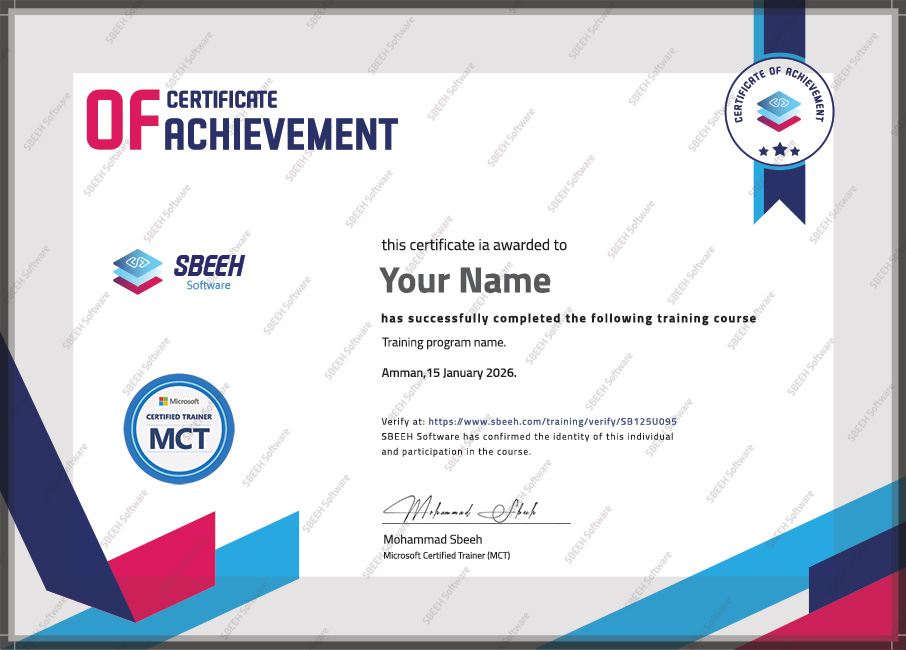

Certificate of Completion
Photo Gallery

Moments From This Training

A look at our training sessions — hands-on training sessions with professionals across Jordan and the GCC.

Interested in this training?

Reach out and we'll help you plan the right training for your team.

Back to all courses