HomeAboutTraining CoursesFAQ
العربيةmohd@sbeeh.com+962 77 984 65 64
SBEEH Software Academy

Instructor-led IT training delivered by Microsoft Certified Trainers (MCT) — in Amman, Jordan, and across the GCC.

Explore

  • About Us
  • IT Training Courses
  • Verify a Certificate
  • FAQ

Get in Touch

  • +962-779846564
  • mohd@sbeeh.com
  • Amman, Jordan

SBEEH Software delivers software development services, advanced technologies implementation, business process automation, IT consulting, and professional IT training led by Microsoft Certified Trainers (MCT) for organizations across Jordan, Saudi Arabia, UAE, Qatar, Kuwait, Bahrain & Oman.

© SBEEH Software. All rights reserved. 2026.

Back to Training Courses
SQL Server Database Administration
DatabaseAdvancedFace to Face / Online

SQL Server Database Administration

SQL Server Database Administration is an advanced Database course delivered in person and online by SBEEH Software Academy in Amman, Jordan.

5 Days (40 Hours)

Last updated August 16, 2026

This 5-day, advanced course prepares IT professionals to install, configure, secure, and operate Microsoft SQL Server as production database administrators. Unlike development-focused SQL courses, this course is built entirely around DBA operational responsibilities: installation and configuration, security and permissions, backup and recovery, automation, and performance monitoring — the day-to-day and on-call responsibilities of running SQL Server in production.

Participants install and configure a SQL Server instance following best practices, design a security model with logins, users, and role-based permissions, implement a complete backup and restore strategy (full, differential, transaction log), automate maintenance with SQL Server Agent jobs, and monitor server health and troubleshoot performance issues using Dynamic Management Views (DMVs) and Extended Events.

This course is designed for IT administrators and database professionals who will be responsible for keeping SQL Server instances running reliably and securely in production, as distinct from developers who write application code against the database (covered in the separate SQL Server Database Development course). It supports preparation for Microsoft's Azure Database Administrator Associate (DP-300) certification for teams extending these skills into Azure SQL.
Official reference: Microsoft Learn: SQL Server documentation

Day 1: Installation, Configuration, and Server Architecture

Main Topics:

  • SQL Server editions and licensing
  • Installation and post-install configuration
  • Server and database-level configuration options
  • SQL Server architecture: instances, databases, files

Detailed Subtopics:

  • Choosing service accounts and collation settings correctly at install time
  • tempdb configuration best practices
  • Memory and CPU configuration for SQL Server
  • Configuring database file placement and growth settings

Hands-On Lab: Install a new SQL Server instance following a documented configuration checklist, then configure tempdb and memory settings for a multi-core server.

Real-World Scenario: A new SQL Server instance needs to be provisioned for a production application, following the organization's configuration standards.

Learning Outcome: Participants can install and correctly configure a SQL Server instance ready for production workloads.

Day 2: Security and Access Control

Main Topics:

  • Authentication modes: Windows vs. SQL authentication
  • Logins, users, and database roles
  • Object-level and column-level permissions
  • Auditing and Transparent Data Encryption (TDE)

Detailed Subtopics:

  • Principle of least privilege in permission design
  • Custom roles vs. built-in fixed roles
  • Row-level security overview
  • Configuring server and database auditing

Hands-On Lab: Design and implement a role-based security model for a multi-application database, including a custom role with restricted column access, then enable auditing on sensitive tables.

Real-World Scenario: An auditor has flagged that all application users currently connect with a shared sysadmin account, with no traceability of who changed what.

Learning Outcome: Participants can design and implement a least-privilege security model with proper auditing in place.

Day 3: Backup, Restore, and Recovery Strategies

Main Topics:

  • Recovery models (simple, full, bulk-logged)
  • Full, differential, and transaction log backups
  • Point-in-time restore
  • Backup automation and verification

Detailed Subtopics:

  • Choosing a recovery model based on RPO/RTO requirements
  • Restoring to a specific point in time after a failure
  • Verifying backup integrity (CHECKSUM, RESTORE VERIFYONLY)
  • Backup compression and storage strategy

Hands-On Lab: Configure a full/differential/log backup schedule for a database, simulate a failure, and perform a point-in-time restore to recover data lost after the last backup.

Real-World Scenario: A production database was accidentally corrupted by a bad deployment script at 2:15 PM, and data must be recovered to exactly 2:00 PM with minimal loss.

Learning Outcome: Participants can design and execute a backup and recovery strategy that meets a defined recovery point and recovery time objective.

Day 4: Automation, Maintenance, and SQL Server Agent

Main Topics:

  • SQL Server Agent jobs, schedules, and alerts
  • Index and statistics maintenance
  • Database Mail and operator notifications
  • Maintenance plans vs. custom scripts

Detailed Subtopics:

  • Building multi-step jobs with proper failure handling
  • Automating index rebuilds/reorganizes based on fragmentation
  • Configuring alerts for job failures and severity-level errors
  • Scripting maintenance tasks for portability across servers

Hands-On Lab: Build a SQL Server Agent job that performs index maintenance based on fragmentation level and emails an alert on failure.

Real-World Scenario: Index fragmentation has been growing unchecked for months because maintenance was being done manually and inconsistently.

Learning Outcome: Participants can automate routine DBA maintenance tasks reliably, with proper alerting when something goes wrong.

Day 5: Monitoring, Troubleshooting, and Performance

Main Topics:

  • Dynamic Management Views (DMVs) for health monitoring
  • Extended Events for diagnostics
  • Identifying blocking and deadlocks
  • Capstone: incident response scenario

Detailed Subtopics:

  • Key DMVs for CPU, memory, and I/O bottlenecks
  • Capturing and analyzing an Extended Events session
  • Reading and resolving blocking chains
  • Building a monitoring checklist for daily DBA health checks

Hands-On Lab: Diagnose a simulated production incident (blocking, high CPU, and a failing job) using DMVs and Extended Events, and document the root cause and fix.

Real-World Scenario: Users are reporting the application has become extremely slow, and it's 8 AM with no clear cause yet — a realistic on-call DBA incident.

Learning Outcome: Participants leave able to systematically diagnose and resolve a live SQL Server performance incident using the correct built-in diagnostic tools.

Frequently Asked Questions

Additional Notes


Who Is This For?

This is an advanced course for IT professionals who own the operational health, security, and availability of SQL Server, not application developers.

  • IT administrators and database administrators managing production SQL Server instances
  • Infrastructure engineers taking on DBA responsibilities for the first time
  • Technical consultants who deploy and support SQL Server for clients
  • IT managers who need a deep technical understanding of DBA operations for staffing and planning

Prerequisites

This is an advanced, DBA-focused course; participants should already have SQL Server experience before attending.

  • Working knowledge of T-SQL and relational database concepts
  • Prior hands-on exposure to SQL Server (any DBA or advanced developer experience)
  • Basic Windows Server administration knowledge
  • Access to SQL Server 2019/2022 for hands-on labs (provided in the training environment)

What certificate do I get after this course?

Upon successful completion of the training, participants will receive an official Certificate of Completion.
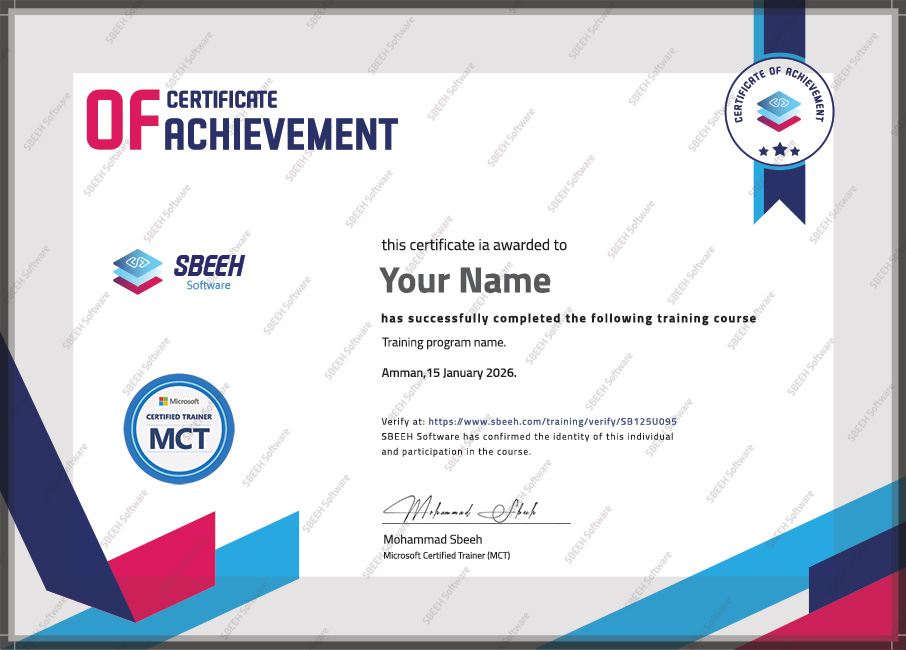

Certificate of Completion
Photo Gallery

Moments From This Training

A look at our training sessions — hands-on training sessions with professionals across Jordan and the GCC.

Interested in this training?

Reach out and we'll help you plan the right training for your team.

Back to all courses