HomeAboutTraining CoursesFAQ
العربيةmohd@sbeeh.com+962 77 984 65 64
SBEEH Software Academy

Instructor-led IT training delivered by Microsoft Certified Trainers (MCT) — in Amman, Jordan, and across the GCC.

Explore

  • About Us
  • IT Training Courses
  • Verify a Certificate
  • FAQ

Get in Touch

  • +962-779846564
  • mohd@sbeeh.com
  • Amman, Jordan

SBEEH Software delivers software development services, advanced technologies implementation, business process automation, IT consulting, and professional IT training led by Microsoft Certified Trainers (MCT) for organizations across Jordan, Saudi Arabia, UAE, Qatar, Kuwait, Bahrain & Oman.

© SBEEH Software. All rights reserved. 2026.

Back to Training Courses
SQL Server Database Development
DatabaseIntermediateFace to Face / Online

SQL Server Database Development

SQL Server Database Development is an intermediate Database course delivered in person and online by SBEEH Software Academy in Amman, Jordan.

5 Days (40 Hours)

Last updated August 16, 2026

This 5-day, intermediate-level course develops the T-SQL and database design skills needed to build the data layer of enterprise applications on Microsoft SQL Server. Rather than covering SQL syntax in isolation, the course is organized around how a real application's database evolves: from schema design and normalization, through T-SQL programming (stored procedures, functions, and triggers), to query tuning and indexing for production workloads.

Participants design a normalized schema for a sample line-of-business application, implement the business logic layer using stored procedures and functions, enforce data integrity with constraints and triggers, and learn to read execution plans to diagnose slow queries — a skill most developers never formally learn but need constantly in production.

This course targets developers and database developers who already write basic SELECT queries but need to design schemas and write production-quality T-SQL, as well as backend developers whose applications talk to SQL Server and who want to stop treating the database as a black box. It complements Entity Framework Core training for teams building .NET applications, and pairs well with the separate SQL Server Database Administration course for teams that also need operational DBA skills.
Official reference: Microsoft Learn: SQL Server documentation

Day 1: Relational Database Design and Normalization

Main Topics:

  • Entity-relationship modeling
  • Normalization (1NF–3NF) and denormalization trade-offs
  • Choosing data types and keys
  • Designing constraints

Detailed Subtopics:

  • Primary vs. foreign keys and referential integrity
  • Surrogate vs. natural keys
  • CHECK, UNIQUE, and DEFAULT constraints
  • When controlled denormalization improves read performance

Hands-On Lab: Design and create a normalized schema (customers, orders, products) for a sample retail application using SQL Server Management Studio.

Real-World Scenario: A growing retail company's spreadsheet-based order tracking needs to become a proper relational database before it breaks under duplicate and inconsistent data.

Learning Outcome: Participants can design a normalized schema with appropriate keys and constraints for a real business domain.

Day 2: T-SQL Fundamentals and Data Manipulation

Main Topics:

  • SELECT, JOIN, and subqueries in depth
  • INSERT/UPDATE/DELETE and MERGE
  • Aggregations and window functions
  • Common Table Expressions (CTEs)

Detailed Subtopics:

  • INNER vs. OUTER vs. CROSS APPLY
  • ROW_NUMBER(), RANK(), and PARTITION BY
  • Recursive CTEs for hierarchical data
  • Transactions and isolation levels

Hands-On Lab: Write a set of reporting queries against the Day 1 schema, including a running-total report using window functions and a recursive CTE for a category hierarchy.

Real-World Scenario: The sales team needs a running month-to-date revenue report and a report showing the full category tree for the product catalog.

Learning Outcome: Participants can write complex multi-table queries, including window functions and recursive CTEs, confidently and correctly.

Day 3: Stored Procedures, Functions, and Triggers

Main Topics:

  • Writing stored procedures with parameters
  • Scalar and table-valued functions
  • DML triggers (AFTER/INSTEAD OF)
  • Error handling with TRY/CATCH

Detailed Subtopics:

  • Output parameters and return values
  • Encapsulating business rules in stored procedures
  • Using triggers for auditing vs. why to avoid overusing them
  • THROW vs. RAISERROR

Hands-On Lab: Implement the order-placement business logic as a stored procedure with proper error handling, plus an audit trigger that logs price changes on the products table.

Real-World Scenario: The application team needs a single stored procedure that validates stock, creates an order, and updates inventory atomically.

Learning Outcome: Participants can encapsulate business logic safely in T-SQL objects and handle errors correctly inside transactions.

Day 4: Indexing and Query Performance Tuning

Main Topics:

  • Clustered vs. non-clustered indexes
  • Reading execution plans
  • Identifying missing/unused indexes
  • Query rewriting for performance

Detailed Subtopics:

  • Index seeks vs. scans
  • Covering indexes and included columns
  • Statistics and the query optimizer
  • Common anti-patterns (SELECT *, non-SARGable predicates)

Hands-On Lab: Diagnose and fix three deliberately slow queries against a larger sample dataset using execution plans, then measure the before/after improvement.

Real-World Scenario: A reporting query that used to run in seconds now takes minutes as the orders table has grown to millions of rows.

Learning Outcome: Participants can read an execution plan, identify the bottleneck, and apply the correct indexing or query fix.

Day 5: Advanced Programming Patterns and Capstone

Main Topics:

  • Dynamic SQL (safely)
  • Table types and table-valued parameters
  • Views and security through views
  • Capstone project

Detailed Subtopics:

  • Preventing SQL injection in dynamic SQL
  • Passing sets of data efficiently into stored procedures
  • Schema-bound vs. non-schema-bound views

Hands-On Lab: Build a small end-to-end feature: a table-valued parameter used to bulk-insert order lines, wrapped in a stored procedure, exposed through a reporting view.

Real-World Scenario: The application needs to insert a shopping cart with dozens of line items in a single efficient database call rather than one round trip per row.

Learning Outcome: Participants leave with a complete, working set of database objects (schema, procedures, functions, triggers, indexes, views) representing a small production-ready application backend.

Frequently Asked Questions

Additional Notes


Who Is This For?

This course is aimed at developers who build the data layer of applications on SQL Server, not at DBAs managing servers.

  • Backend/full-stack developers writing the data-access layer of an application
  • Database developers responsible for schema design and stored procedures
  • Data professionals moving from spreadsheet or Access-based systems to SQL Server
  • Technical consultants scoping database designs for client projects

Prerequisites

Participants should already be comfortable writing basic SQL queries before attending.

  • Ability to write basic SELECT queries with WHERE and simple JOINs
  • Familiarity with relational database concepts (tables, keys) is helpful
  • No prior T-SQL programming (procedures/functions) experience required
  • SQL Server 2019 or later and SQL Server Management Studio for labs

What certificate do I get after this course?

Upon successful completion of the training, participants will receive an official Certificate of Completion.
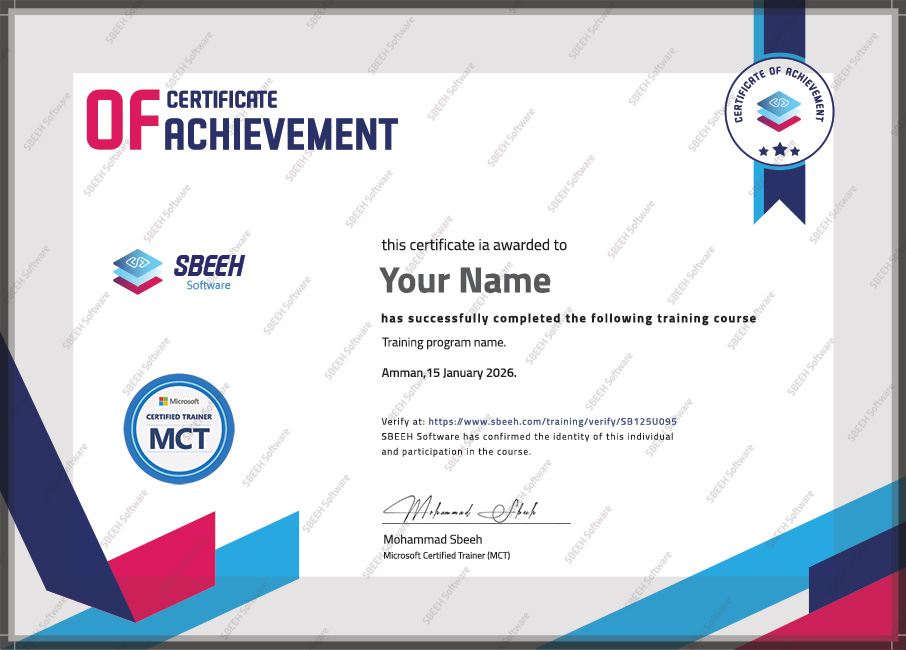

Certificate of Completion
Photo Gallery

Moments From This Training

A look at our training sessions — hands-on training sessions with professionals across Jordan and the GCC.

Interested in this training?

Reach out and we'll help you plan the right training for your team.

Back to all courses