HomeAboutTraining CoursesFAQ
العربيةmohd@sbeeh.com+962 77 984 65 64
SBEEH Software Academy

Instructor-led IT training delivered by Microsoft Certified Trainers (MCT) — in Amman, Jordan, and across the GCC.

Explore

  • About Us
  • IT Training Courses
  • Verify a Certificate
  • FAQ

Get in Touch

  • +962-779846564
  • mohd@sbeeh.com
  • Amman, Jordan

SBEEH Software delivers software development services, advanced technologies implementation, business process automation, IT consulting, and professional IT training led by Microsoft Certified Trainers (MCT) for organizations across Jordan, Saudi Arabia, UAE, Qatar, Kuwait, Bahrain & Oman.

© SBEEH Software. All rights reserved. 2026.

Back to Training Courses
SQL Server High Availability and Disaster Recovery Solutions
DatabaseAdvancedFace to Face / Online

SQL Server High Availability and Disaster Recovery Solutions

SQL Server High Availability and Disaster Recovery Solutions is an advanced Database course delivered in person and online by SBEEH Software Academy in Amman, Jordan.

3 Days (24 Hours)

Last updated August 16, 2026

This 3-day, advanced course teaches database administrators to design and implement high availability (HA) and disaster recovery (DR) solutions for Microsoft SQL Server, with a focus on Always On Availability Groups, failover clustering, and log shipping. The course is built around the central operational question every organization eventually faces: what happens when the primary database server fails, and how much data and downtime can the business actually tolerate?

Participants configure an Always On Availability Group across multiple replicas, design a failover strategy appropriate to defined RPO/RTO targets, configure and test log shipping as a lower-cost DR option, and practice both planned and unplanned failover scenarios so that a real incident is not the first time the process has been executed.

This course is designed for experienced SQL Server DBAs and infrastructure engineers responsible for the uptime and resilience of production databases, building directly on the operational foundation from the SQL Server Database Administration course. It is highly relevant to organizations with compliance or SLA requirements around database uptime and data loss tolerance.
Official reference: Microsoft Learn: SQL Server documentation

Day 1: HA/DR Concepts and Always On Availability Groups Setup

Main Topics:

  • RPO and RTO: defining business requirements
  • HA/DR technology comparison (AGs, FCI, log shipping, replication)
  • Windows Server Failover Clustering prerequisites
  • Configuring an Always On Availability Group

Detailed Subtopics:

  • Synchronous vs. asynchronous commit modes
  • Quorum configuration and witness options
  • Preparing databases for Availability Group membership
  • Listener configuration for client connectivity

Hands-On Lab: Configure a two-replica Always On Availability Group with synchronous commit and a listener, and validate data is replicating correctly.

Real-World Scenario: A financial services application has a strict requirement of near-zero data loss (RPO) if the primary database server fails.

Learning Outcome: Participants can translate business RPO/RTO requirements into an appropriate Availability Group configuration.

Day 2: Failover, Readable Secondaries, and Monitoring

Main Topics:

  • Manual and automatic failover
  • Readable secondary replicas for reporting offload
  • Availability Group monitoring and dashboards
  • Handling failover of connected applications

Detailed Subtopics:

  • Failover modes and quorum implications
  • Routing read-only traffic to secondaries
  • Interpreting the Always On dashboard and DMVs
  • Connection string and application-side failover handling

Hands-On Lab: Perform a planned manual failover and an unplanned (simulated failure) failover, validate the application reconnects correctly, and configure a secondary for reporting queries.

Real-World Scenario: The reporting team's heavy queries are currently slowing down the primary production database and need to be offloaded.

Learning Outcome: Participants can execute both planned and unplanned failovers confidently and offload read workloads to secondary replicas.

Day 3: Disaster Recovery: Log Shipping, Backups, and Capstone

Main Topics:

  • Log shipping configuration and monitoring
  • Combining Availability Groups with a DR site
  • Backup strategy in an HA/DR environment
  • Capstone: full HA/DR runbook exercise

Detailed Subtopics:

  • Configuring log shipping for a lower-cost secondary DR site
  • Multi-site (hybrid HA + DR) architecture patterns
  • Backup responsibilities across primary and secondary replicas
  • Writing a clear, repeatable failover runbook

Hands-On Lab: Configure log shipping to a separate DR server, then run a full simulated disaster scenario combining Availability Group failover and a documented recovery runbook.

Real-World Scenario: A regional outage takes down the primary datacenter entirely, and the DBA team must recover service from the DR site within an agreed 4-hour RTO.

Learning Outcome: Participants leave with hands-on experience executing a complete HA/DR strategy and a documented runbook they can adapt for their own environment.

Frequently Asked Questions

Additional Notes


Who Is This For?

This is an advanced course for experienced DBAs and infrastructure engineers directly responsible for database uptime and resilience.

  • Senior database administrators responsible for production uptime SLAs
  • Infrastructure/systems engineers supporting clustered SQL Server environments
  • Solution architects designing resilient data platforms for compliance-driven organizations
  • IT managers evaluating HA/DR strategy and vendor/technology trade-offs

Prerequisites

This course assumes solid, hands-on SQL Server DBA experience; it is not an introduction to database administration.

  • Solid SQL Server DBA experience (equivalent to the SQL Server Database Administration course)
  • Working knowledge of Windows Server Failover Clustering concepts
  • Understanding of backup and recovery models in SQL Server
  • Access to a multi-node lab environment (provided in training) for Availability Group configuration

What certificate do I get after this course?

Upon successful completion of the training, participants will receive an official Certificate of Completion.
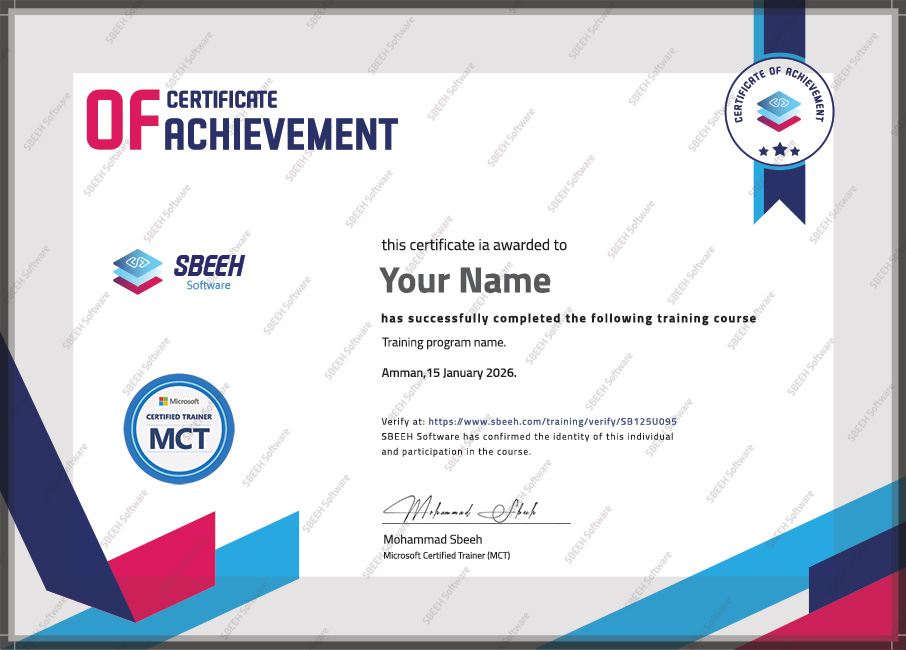

Certificate of Completion
Photo Gallery

Moments From This Training

A look at our training sessions — hands-on training sessions with professionals across Jordan and the GCC.

Interested in this training?

Reach out and we'll help you plan the right training for your team.

Back to all courses