HomeAboutTraining CoursesFAQ
العربيةmohd@sbeeh.com+962 77 984 65 64
SBEEH Software Academy

Instructor-led IT training delivered by Microsoft Certified Trainers (MCT) — in Amman, Jordan, and across the GCC.

Explore

  • About Us
  • IT Training Courses
  • Verify a Certificate
  • FAQ

Get in Touch

  • +962-779846564
  • mohd@sbeeh.com
  • Amman, Jordan

SBEEH Software delivers software development services, advanced technologies implementation, business process automation, IT consulting, and professional IT training led by Microsoft Certified Trainers (MCT) for organizations across Jordan, Saudi Arabia, UAE, Qatar, Kuwait, Bahrain & Oman.

© SBEEH Software. All rights reserved. 2026.

Back to Training Courses
SQL Server Integration Services (SSIS) for ETL Solutions
DatabaseIntermediateFace to Face / Online

SQL Server Integration Services (SSIS) for ETL Solutions

SQL Server Integration Services (SSIS) for ETL Solutions is an intermediate Database course delivered in person and online by SBEEH Software Academy in Amman, Jordan.

3 Days (24 Hours)

Last updated August 16, 2026

This 3-day, intermediate course teaches data professionals to design and build Extract, Transform, Load (ETL) solutions using SQL Server Integration Services (SSIS), the standard Microsoft platform for moving and transforming data between systems. The course follows the lifecycle of a real ETL project: extracting data from heterogeneous sources, cleaning and transforming it reliably, loading it into a data warehouse, and operationalizing the whole pipeline with proper error handling and scheduling.

Participants build SSIS packages using control flow and data flow, implement common transformations (lookups, conditional splits, aggregations, slowly changing dimensions), handle data-quality issues and errors without silently losing or corrupting data, and deploy and schedule packages for production execution using the SSIS Catalog and SQL Server Agent.

This course is designed for database developers, data engineers, and BI professionals responsible for moving data between systems — from source applications into a data warehouse, or between integrated systems — and complements SQL Server Database Development and Power BI training for teams building a complete data platform.
Official reference: Microsoft Learn: SQL Server documentation

Day 1: SSIS Fundamentals and Control Flow

Main Topics:

  • SSIS architecture: packages, control flow, data flow
  • Connection managers and data sources
  • Control flow tasks (Execute SQL, File System, containers)
  • Variables and parameters

Detailed Subtopics:

  • Configuring connection managers for SQL Server, flat files, and Excel
  • For Each Loop and Sequence containers
  • Package and project-level parameters for reusability
  • Precedence constraints and workflow logic

Hands-On Lab: Build a control flow package that loops through a folder of CSV files, loads each one into a staging table, and archives processed files.

Real-World Scenario: A retail company receives a daily batch of sales files from multiple store locations that need to be loaded into a central staging database automatically.

Learning Outcome: Participants can design a control flow workflow for a realistic multi-file, multi-step ETL process.

Day 2: Data Flow Transformations

Main Topics:

  • Data flow fundamentals: sources, transformations, destinations
  • Lookup transformation for dimension matching
  • Conditional Split and Derived Column
  • Aggregations and sorting in the data flow

Detailed Subtopics:

  • Handling lookup failures (no-match rows) correctly
  • Data cleansing and standardization with Derived Column expressions
  • Splitting rows into different destinations based on business rules
  • Performance considerations for large data flows

Hands-On Lab: Build a data flow that loads sales data, uses a Lookup transformation to match products to a dimension table, splits out unmatched rows to an error table, and aggregates results into a summary table.

Real-World Scenario: Some incoming sales records reference product codes that no longer exist in the current product catalog and need to be flagged rather than silently dropped or causing the whole load to fail.

Learning Outcome: Participants can build a data flow using common transformations that handles imperfect real-world data correctly.

Day 3: Error Handling, Slowly Changing Dimensions, and Deployment

Main Topics:

  • Error handling and logging strategies
  • Slowly Changing Dimension (SCD) handling
  • Deploying packages to the SSIS Catalog
  • Scheduling and monitoring with SQL Server Agent

Detailed Subtopics:

  • Redirecting error rows vs. failing the package
  • Type 1 vs. Type 2 SCD patterns for dimension tables
  • Environment configuration for dev/test/prod deployment
  • Setting up alerts for failed ETL jobs

Hands-On Lab: Add proper error handling and logging to the Day 2 package, implement a Type 2 slowly changing dimension for the product table, and deploy and schedule the complete solution via the SSIS Catalog and SQL Server Agent.

Real-World Scenario: When a product's price or category changes, the data warehouse needs to preserve historical records as they were at the time of each sale, not silently overwrite the history.

Learning Outcome: Participants leave with a complete, error-handled, deployed, and scheduled ETL solution reflecting real production data warehousing requirements.

Frequently Asked Questions

Additional Notes


Who Is This For?

This course is for people who build and operate the data pipelines that move and transform data between systems.

  • Database developers and data engineers building ETL/data warehouse pipelines
  • BI professionals responsible for the data layer feeding Power BI or Report Server
  • IT professionals integrating data between multiple business systems
  • Technical consultants delivering data warehousing or data migration projects

Prerequisites

Working SQL/T-SQL knowledge is required; this is not a first course in databases.

  • Working knowledge of T-SQL querying (equivalent to Querying and Managing Data with Transact-SQL)
  • Basic understanding of relational database and data warehousing concepts (fact/dimension tables helpful but taught in the course)
  • Familiarity with SQL Server Management Studio
  • SQL Server and SQL Server Data Tools (SSDT) for hands-on labs

What certificate do I get after this course?

Upon successful completion of the training, participants will receive an official Certificate of Completion.
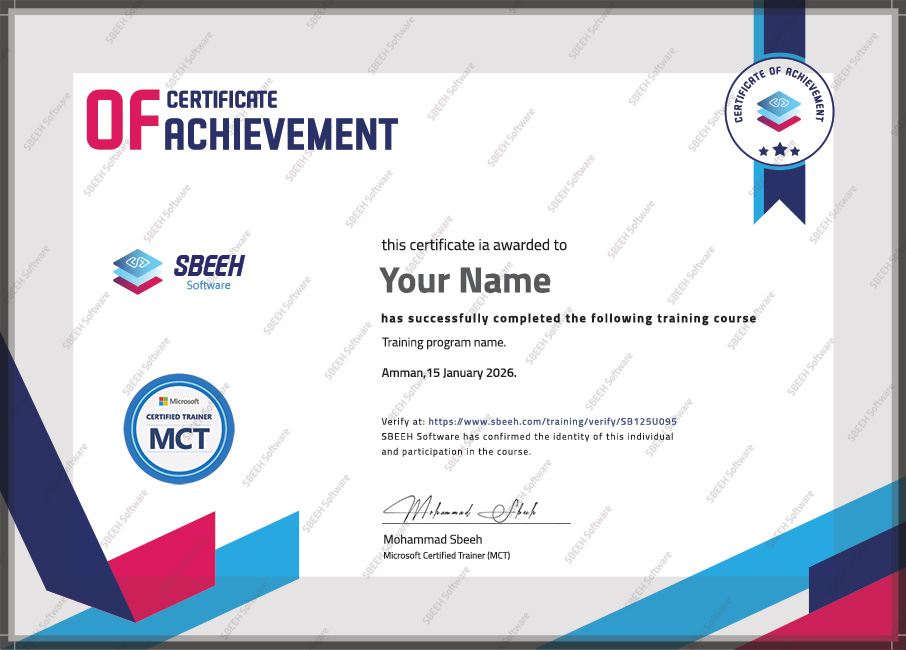

Certificate of Completion
Photo Gallery

Moments From This Training

A look at our training sessions — hands-on training sessions with professionals across Jordan and the GCC.

Interested in this training?

Reach out and we'll help you plan the right training for your team.

Back to all courses