HomeAboutTraining CoursesFAQ
العربيةmohd@sbeeh.com+962 77 984 65 64
SBEEH Software Academy

Instructor-led IT training delivered by Microsoft Certified Trainers (MCT) — in Amman, Jordan, and across the GCC.

Explore

  • About Us
  • IT Training Courses
  • Verify a Certificate
  • FAQ

Get in Touch

  • +962-779846564
  • mohd@sbeeh.com
  • Amman, Jordan

SBEEH Software delivers software development services, advanced technologies implementation, business process automation, IT consulting, and professional IT training led by Microsoft Certified Trainers (MCT) for organizations across Jordan, Saudi Arabia, UAE, Qatar, Kuwait, Bahrain & Oman.

© SBEEH Software. All rights reserved. 2026.

Back to Training Courses
Microsoft Azure AI Solutions Development
AI & Machine LearningAdvancedFace to Face / Online

Microsoft Azure AI Solutions Development

Microsoft Azure AI Solutions Development is an advanced AI & Machine Learning course delivered in person and online by SBEEH Software Academy in Amman, Jordan.

4 Days (32 Hours)

Last updated August 16, 2026

This 4-day, advanced course teaches developers to build applications powered by Azure AI services, aligned with the skills measured in Microsoft's AI-102 exam. The course covers both pre-built Azure AI services (vision, language, and document processing) and generative AI application development using Azure OpenAI Service, with an emphasis on integrating these services into real applications responsibly and cost-effectively.

Participants integrate Azure AI Vision and Document Intelligence for image and document processing, build natural language features using Azure AI Language (sentiment analysis, entity extraction, custom classification), build a retrieval-augmented generation (RAG) application using Azure OpenAI Service and Azure AI Search, and implement responsible AI practices including content filtering and prompt injection mitigation.

This course is designed for developers who already build applications on Azure (equivalent to the Microsoft Azure Development for Cloud Solutions course) and are now adding AI-powered features, and for solution architects evaluating how to integrate generative AI responsibly into an existing product. It assumes working knowledge of REST APIs and application development, not a data science or machine learning background.
Official reference: Microsoft Learn: Azure AI documentation

Day 1: Azure AI Services Fundamentals and Vision

Main Topics:

  • Azure AI services overview and resource provisioning
  • Azure AI Vision: image analysis and OCR
  • Azure AI Document Intelligence
  • Responsible AI principles

Detailed Subtopics:

  • Choosing between multi-service and single-service AI resources
  • Extracting text and structured data from scanned documents
  • Custom document models for domain-specific forms
  • Introduction to Microsoft's Responsible AI Standard

Hands-On Lab: Build a .NET application that uses Azure AI Document Intelligence to extract structured data (vendor, amount, date) from a folder of scanned invoices.

Real-World Scenario: An accounts payable team manually re-keys data from hundreds of PDF invoices every week into their accounting system.

Learning Outcome: Participants can integrate Azure AI Vision and Document Intelligence into an application to automate real document-processing work.

Day 2: Azure AI Language and Custom Models

Main Topics:

  • Sentiment analysis and key phrase extraction
  • Named entity recognition
  • Custom text classification and extraction
  • Language Understanding (conversational language understanding)

Detailed Subtopics:

  • Building a custom classification model with labeled training data
  • Extracting domain-specific entities (e.g., product names, contract terms)
  • Integrating language features into an existing application via REST/SDK
  • Evaluating model accuracy before production use

Hands-On Lab: Build and train a custom text classification model to automatically route incoming customer support emails to the correct department based on content, and integrate it into a sample support application.

Real-World Scenario: Customer support emails are currently triaged manually by a single team member who reads every message before forwarding it.

Learning Outcome: Participants can train and integrate a custom language model into an application for a real classification task.

Day 3: Generative AI with Azure OpenAI Service

Main Topics:

  • Azure OpenAI Service fundamentals
  • Prompt engineering for application scenarios
  • Function calling and structured outputs
  • Cost and token management

Detailed Subtopics:

  • Choosing the right model for a given task and budget
  • Designing system prompts for consistent, reliable outputs
  • Using function calling to connect a model to application logic
  • Estimating and monitoring token usage/cost

Hands-On Lab: Build an application feature that uses Azure OpenAI with function calling to let users ask natural-language questions that are answered by querying a real application database.

Real-World Scenario: Internal staff want to ask questions like 'how many orders shipped late last month' in plain English instead of learning a reporting tool.

Learning Outcome: Participants can build a working generative AI feature that reliably connects natural language input to real application data and actions.

Day 4: Retrieval-Augmented Generation and Responsible AI

Main Topics:

  • Azure AI Search and vector search
  • Building a RAG pipeline
  • Content filtering and prompt injection mitigation
  • Capstone: complete AI-powered feature

Detailed Subtopics:

  • Chunking and embedding documents for retrieval
  • Grounding model responses in an organization's own data
  • Configuring Azure OpenAI content filters
  • Detecting and mitigating prompt injection in user-facing AI features

Hands-On Lab: Build a RAG-based Q&A feature that answers questions grounded in a set of internal company documents, with content filtering and basic prompt-injection safeguards in place.

Real-World Scenario: Employees need to be able to ask questions about internal HR policy documents and get accurate, grounded answers rather than the model guessing or hallucinating an answer.

Learning Outcome: Participants leave with a complete, working RAG application and a practical understanding of the responsible AI safeguards required before shipping such a feature to production, aligned with AI-102 exam objectives.

Frequently Asked Questions

Additional Notes


Who Is This For?

This course is for application developers adding AI-powered features to real products, not for data scientists building models from scratch.

  • Developers building AI-powered features into existing or new applications
  • Solution architects integrating generative AI responsibly into a product
  • Backend/full-stack developers extending an application with document, language, or vision AI
  • Technical leads evaluating Azure AI and Azure OpenAI Service for a project

Prerequisites

This course assumes working application development experience on Azure; it is not a data science or machine learning fundamentals course.

  • Working knowledge of Azure application development (equivalent to the Microsoft Azure Development for Cloud Solutions course)
  • Comfortable programming experience in C# or another mainstream language, and REST API integration
  • No prior machine learning or data science background required
  • An Azure subscription with access to Azure OpenAI Service for hands-on labs

What certificate do I get after this course?

Upon successful completion of the training, participants will receive an official Certificate of Completion.
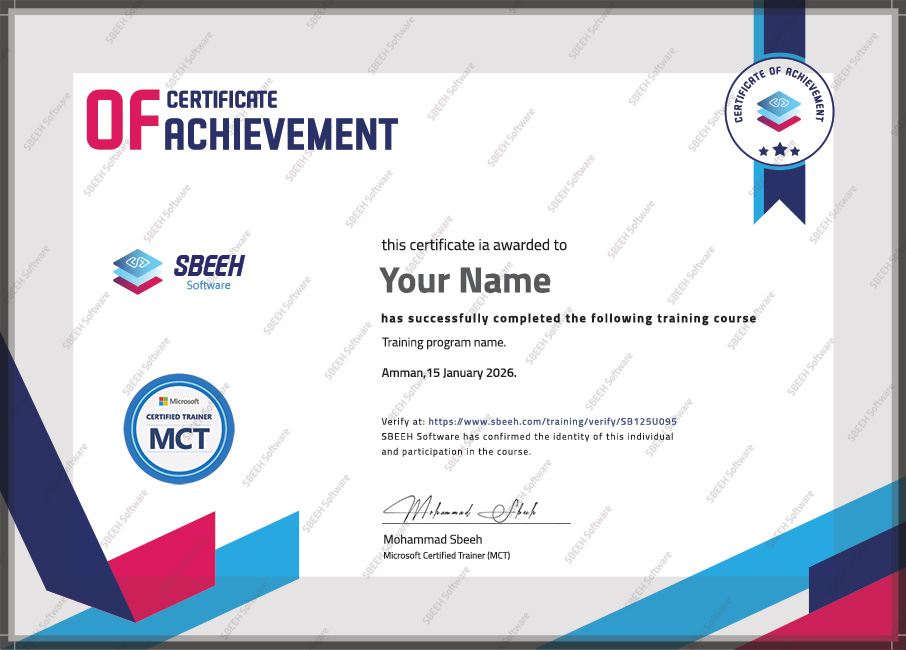

Certificate of Completion
Photo Gallery

Moments From This Training

A look at our training sessions — hands-on training sessions with professionals across Jordan and the GCC.

Interested in this training?

Reach out and we'll help you plan the right training for your team.

Back to all courses